 Skip to content

In the field of architecture and interior design, light is not simply a functional element; it is the tool capable of altering the perception of space, creating atmospheres and guiding the user’s experience. However, to master light, it is essential to thoroughly understand the types of luminaires available on the market and how each one interacts with the environment.
For professionals in the sector — architects, interior designers and specifiers — choosing the right luminaire goes beyond aesthetics. It involves understanding photometry, the protection rating (IP), the colour temperature and the colour rendering index (CRI). At Insolit, as specialised manufacturers of high-end technical and decorative lighting, we understand that each project demands a specific solution.
In this article we break down the different types of luminaires by installation, function and location, integrating solutions from our catalogue that exemplify excellence in design and manufacturing.
Classification by type of installation
The way a luminaire is integrated into the architecture defines the character of the space. A sculptural piece dominating the centre of a room is not the same as a technical projector that seeks to go unnoticed.
Suspension luminaires: hierarchy and volume
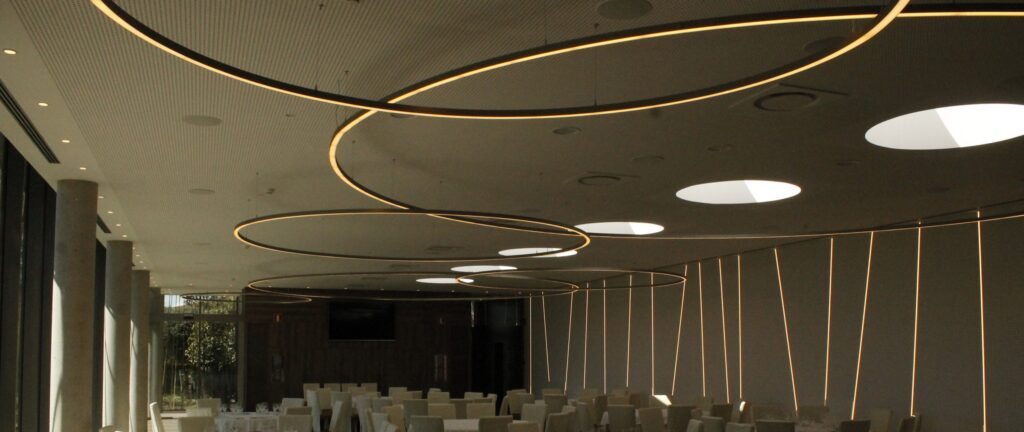
Suspension luminaires are often the protagonists of the design. Their role is twofold: to illuminate the working plane (such as a dining table or a kitchen island) and to add volume to the room’s air space.
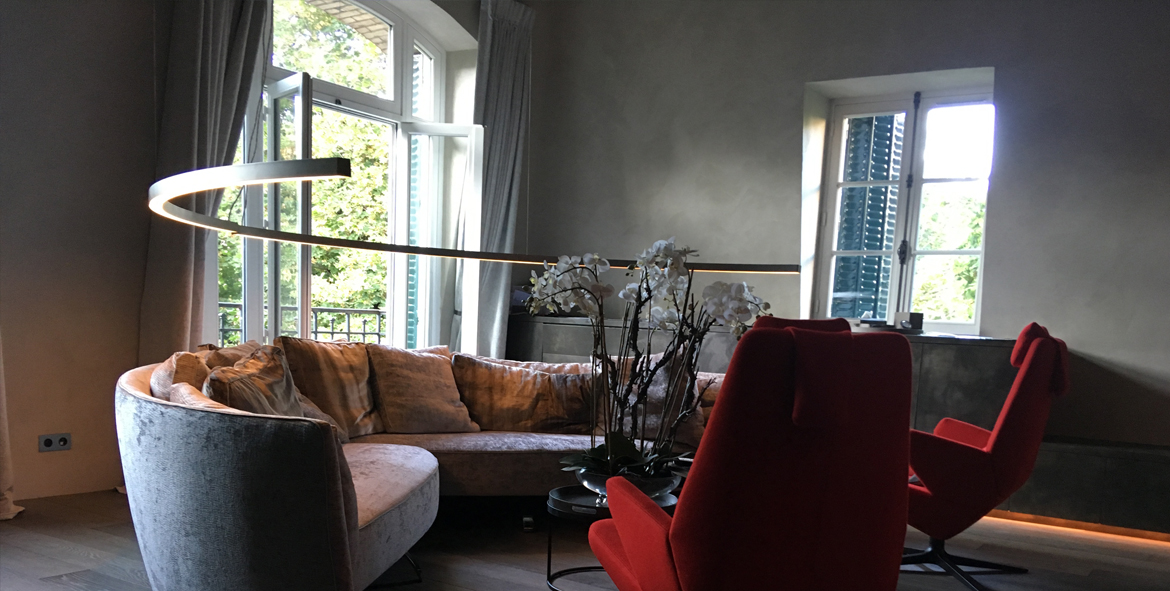
In double-height spaces or large receptions, it is vital to have pieces that fill the void without saturating. Here the TR Huge stands out, a huge circular luminaire in curved aluminium profile that offers a commanding presence with direct light. Its customisation capacity allows it to be adapted to large-scale projects.
For more linear and minimalist designs, the combination of direct and indirect light is on trend. The TR Line & Up model integrates focal projectors to accent surfaces while bathing the ceiling with diffuse light, balancing contrasts.
If we are looking for a more ethereal and sophisticated aesthetic, the use of noble materials such as glass is fundamental. The Focus Line Pendant, with its decorative optical borosilicate glass and machined aluminium body, is the perfect example of how a technical luminaire can be transformed into a decorative jewel.
Ceiling and surface luminaires: versatility and integration
When ceiling height is limited or a clean aesthetic is sought, ceiling luminaires are the preferred choice. Within the ceiling luminaire types, we distinguish between recessed, surface-mounted and track systems.
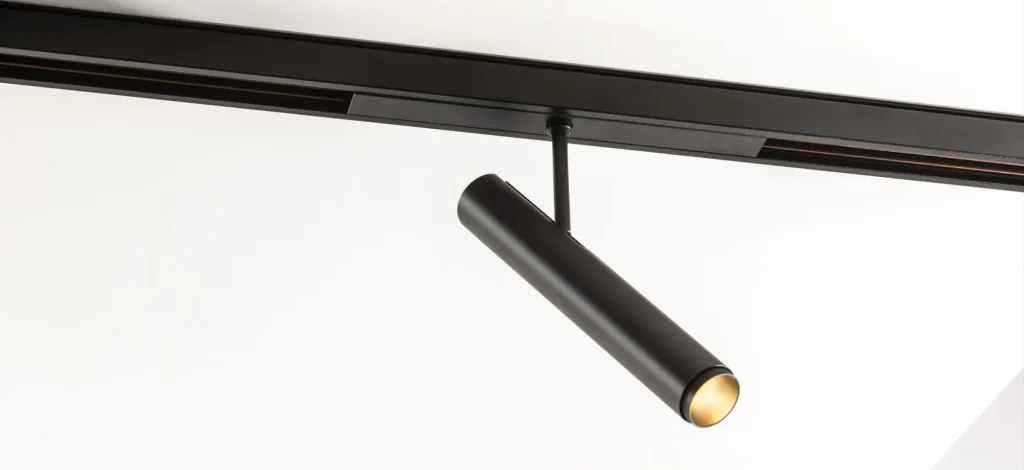
Track systems, especially low-voltage (48V), are the favourite solution for contemporary architects thanks to their flexibility. The Stick Track System 48v allows accent projectors to be combined with lines of diffuse light, adapting to changes in furniture layout without the need for new building works.
For surface installations where recessing is not possible, the aesthetic of the visible “canister” or cylinder brings rhythm to the ceiling. The Stick Ceiling, with its deep matte-black anti-glare and slim stem, offers exceptional visual comfort (low UGR), ideal for hotels and luxury residences.
Wall sconces: washers and signage
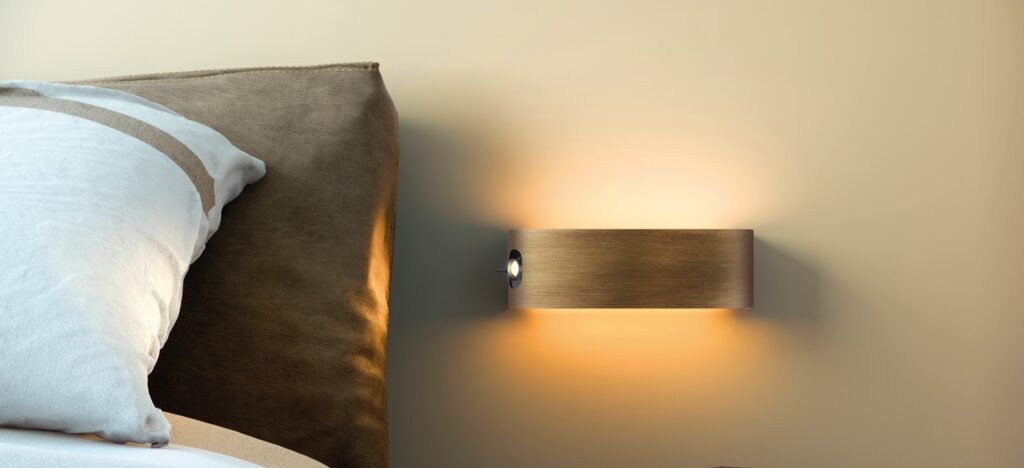
Vertical lighting is crucial to define the limits of the space. Sconces can work as general, accent or reading light.
In the bedroom, functionality is key. The Spy model combines an adjustable direct reading light with general indirect light, solving all headboard needs in a single piece. Similarly, the Stick Bed offers a minimalist and adjustable aesthetic for night reading.
For more dramatic and decorative effects, luminaires such as Plaqué play with depth and shadow, allowing wall compositions that work as light art even when switched off.
Floor luminaires: sculpture and flexibility
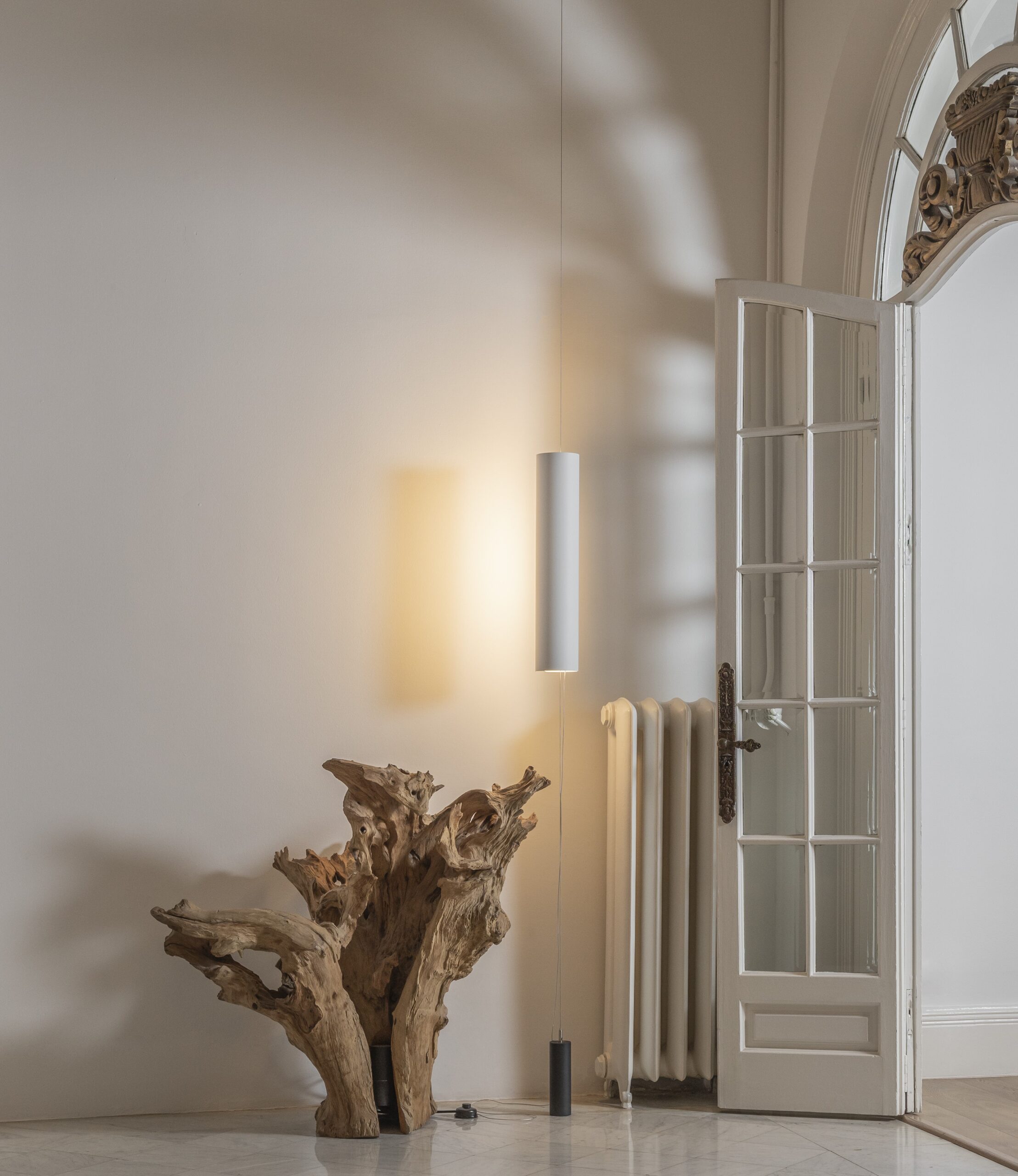
Floor lamps are mobile elements that let you modify the atmosphere of a room without fixed electrical installation. They are perfect for creating reading corners or providing soft ambient light.
We highlight the innovation of the Inside Tensor model. This luminaire defies gravity with a floor-to-ceiling (or wall) tensor system, providing a lateral indirect light that bathes the wall evenly. It is a technical solution that becomes an architectural element.
For a more classic presence with a contemporary twist, the Glass Floor uses a ribbed glass tube that diffuses the light, creating an elegant and timeless luminous totem.
Portable and table luminaires
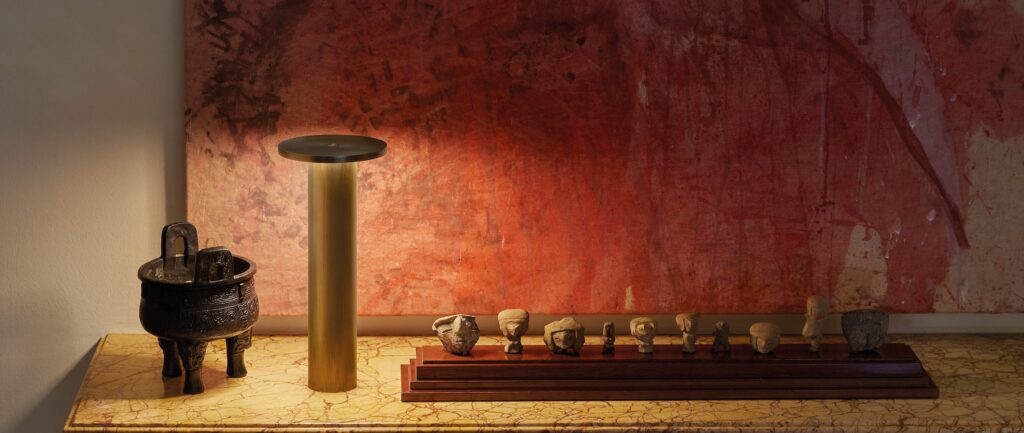
The “nomad” trend in design has driven the development of high-quality battery luminaires. Among the most in-demand types of luminaires in hospitality and terraces are portable ones.
The Basic and the LC (the latter with integrated candle holder) are examples of how machined aluminium and LED technology come together to offer warm and dimmable light anywhere, without cables.
Classification by lighting function
Understanding the light effect is as important as the physical luminaire. Below we categorise by photometric distribution.
Direct and accent light
Used to highlight objects, textures or work areas. It requires precise optics and glare control. The Focus Line family is the specialist in this field. From the Focus Line Micro for display cases and small details, to the Focus Line Track for art galleries or retail, these luminaires let you direct the beam exactly where it is needed.
Indirect and ambient light
It seeks comfort and visual spaciousness by bouncing light off ceilings or walls. Insolit’s TR collection is expert in this. Models such as the TR Up or the TR Wall emit light towards architectural surfaces, softening shadows and broadening the spatial perception.
Diffuse light
It provides general and homogeneous lighting. The use of polycarbonate gel diffusers or ribbed glass, as in the Glass Table, ensures the light source is not visible directly, avoiding glare and creating a relaxed atmosphere.
Luminaires by environment and protection rating (IP)
A common specification mistake is not considering the appropriate IP rating for each zone. Types of luminaires must be selected rigorously according to whether they will be indoors, outdoors or in wet zones.
Bathroom lighting (wet zone)
In bathrooms, safety and moisture resistance are paramount (minimum IP44 in certain zones). But safety should not be at odds with design.
The TR Moon is a perfect “all-in-one” solution for high-end bathrooms. It integrates a circular mirror with dimmable perimeter light and IP44 protection. Its frontal light is ideal for personal grooming as it does not generate shadows on the face.
For point lighting in bathrooms, the Focus Line IP 44 lets you bring the technical aesthetics from the rest of the home to the bathroom, while maintaining the necessary tightness against splashes.
Outdoor and landscape lighting
The outdoors demands robustness. Materials must resist corrosion, UV radiation and the ingress of water and dust (IP65 or above). Anodised aluminium and AISI 316 stainless steel are standards at Insolit.
To light paths or highlight low vegetation, beacons are essential. The Banus luminaire and its double version Banus Twice offer unique versatility: they are adjustable micro-projectors that work as path-marking. This makes it possible not only to mark the way, but also to direct the light towards shrubs or nearby stone textures.
For larger trees or facades, spike projectors are required. The Focus Line Spike or the Focus Line Floor Spike let you plant the luminaire directly into the ground, making it easier to relocate as the garden grows and changes.
The importance of the light source and materiality
When discussing types of luminaires, we cannot ignore the heart of the matter: the light source. At Insolit we are committed to high-quality LED technology.
Integrated LED vs. GU10 retrofit
There are two philosophies. Luminaires with integrated LED (PCB designed by Insolit) allow slimmer designs and specific optimised outputs, as seen in the Stick or TR collections. They guarantee perfect thermal management and long lifespan.
On the other hand, the versatility of the replaceable GU10 bulb is still valued for ease of maintenance. Models such as the Focus Line (in their ceiling, wall or track versions) are designed to accommodate these bulbs, allowing the user to change the colour temperature or the beam angle simply by replacing the lamp, without touching the installation.
Materials and finishes
The durability of a luminaire depends on its construction. The use of machined and extruded aluminium not only brings a premium aesthetic and a solid feel, but also acts as a heat sink for the LED, extending its lifespan.
Customisation is a pillar at Insolit. The ability to offer finishes in anodised matte black, lacquered white, champagne or custom colours allows the luminaire to blend with the architecture or, on the contrary, contrast with it depending on the designer’s intent.
We help you choose among the different types of luminaires
Choosing among the different types of luminaires is an exercise in balance between technique, aesthetics and functionality. Whether it is a technical projector for a shop, a portable lamp for a restaurant or a large suspension for a hotel lobby, each piece must respond to a clear purpose.
At Insolit, we design and manufacture in Barcelona with the demanding specifier in mind. Our collections are not just objects, they are light tools ready to integrate into the most ambitious projects. We invite you to explore our complete catalogue and discover how our customisable solutions can elevate your next project.
Frequently asked questions about types of luminaires
What types of luminaires are there?
Mainly, luminaires are classified by installation and function into: suspension luminaires (pendants), ceiling (surface fixtures, recessed and tracks), wall (sconces), floor, table and portable. They are also divided by location into indoor and outdoor luminaires (which require specific IP protection ratings).
What are the 4 types of lighting?
In lighting design, we distinguish four layers or types of light:
- General lighting (ambient): provides uniform visibility throughout the space (e.g. TR Moon or Stick Line).
- Task lighting (focal): directed light to perform specific activities such as reading or cooking (e.g. Focus Line or Spy).
- Accent lighting: used to highlight architectural objects, art or textures (e.g. Focus Line Micro).
- Decorative lighting: where the luminaire is an aesthetic object in itself, beyond the light it emits (e.g. Glass Floor).
What are the 4 types of light sources?
Historically and technically, light sources are grouped into:
- Incandescent: traditional filament bulbs (now phased out due to low efficiency).
- Halogen: an evolution of incandescent with better colour rendering but high consumption.
- Fluorescent (and compact): gas discharge lamps, efficient but with limitations in dimming and light quality.
- LED (light emitting diode): today’s dominant technology. It offers maximum efficiency, long lifespan, a variety of colour temperatures and dimming and compact-design capabilities, such as the PCBs used by Insolit.
What are the 3 types of lamps?
Although the term “lamp” can refer to the bulb or to the fixture (luminaire), in the context of current light sources three main technologies stand out for their market relevance:
- LED lamps: the most used thanks to sustainability and versatility.
- Discharge lamps: (such as metal halide or sodium), still used in industrial lighting or older street lighting, although being replaced by LED.
Halogen lamps: still present in certain decorative niches for their warmth, although increasingly restricted by regulation in favour of LED.
Note: in everyday design language, floor, table and ceiling lamps are sometimes referred to as the three main groups of lighting furniture.
Explore all the typologies in the Insolit designer ceiling lamps collection.