 Skip to content

The bathroom has ceased to be a merely functional space to become one of the most demanding territories of contemporary interior design. A place where intimacy, well-being and aesthetics converge under the same roof —and where lighting, far from being a secondary detail, reveals itself as the element that defines the atmosphere, the perception of volume and the quality of the everyday experience.
For the architect, the interior designer or the lighting designer, the question of what type of lamp to use in the bathroom does not admit a simple answer. It is not just about choosing a luminaire that resists humidity: it is about specifying a solution that integrates regulatory safety, colour performance, colour temperature and an aesthetic presence capable of dialoguing with the materials of the space —marble, ceramic, wood, glass— without saturating it.
At Insolit, we have spent years manufacturing designer luminaires in Barcelona for projects that demand exactly that: pieces that work as sculptures of light, objects that dress the air even when switched off. Below, we break down the technical and aesthetic keys that every professional must master in order to light the bathroom with criteria and sensitivity.
What type of lamp to use in the bathroom according to regulations: IP protection as a starting point
Before talking about aesthetics or colour temperature, the specifier faces an unavoidable requirement: the electrical safety regulations in wet areas. The IP protection rating (Ingress Protection) classifies the degree of resistance of a luminaire to the penetration of solids and liquids. In the context of the bathroom, this classification is not optional; it is the foundation on which any responsible lighting project is built.
The bathroom zones and their protection requirements
The electrical regulations establish differentiated zones within the bathroom according to proximity to water. Zone 0 (the interior of the bathtub or shower) requires a minimum of IP67 and very low voltage supply. Zone 1 (above the bathtub or shower tray up to 2.25 m in height) requires at least IP44, although IP65 is recommended where there is a risk of direct jets. Zone 2 (up to 60 cm around zone 1) needs a minimum of IP44 to guarantee protection against splashes. Outside these zones, luminaires can have IP20 protection, although many professionals opt for IP44 throughout the room to offer greater safety and flexibility in the distribution of furniture.
It is precisely in these zones that luminaires with specific certifications make sense, such as the Focus Line IP 44 by Insolit, an orientable projector designed by the architect Jean-Michel Wilmotte that combines IP44 and Class II certification with a machined aluminium body of marked architectural aesthetics. Its front ring and rear cover in matte black anodising bring an industrial elegance that transcends the protective function to become a design element with its own character.
Types of bathroom luminaires: From perimeter light to directional beam
Understanding what type of lamp to use in the bathroom involves knowing the different typologies available and understanding what function each one fulfils within the overall lighting scheme. There is no single correct answer: the key lies in the strategic combination of layers of light that respond to the different needs of the space.
Wall lights with integrated mirror: The fusion of function and sculpture
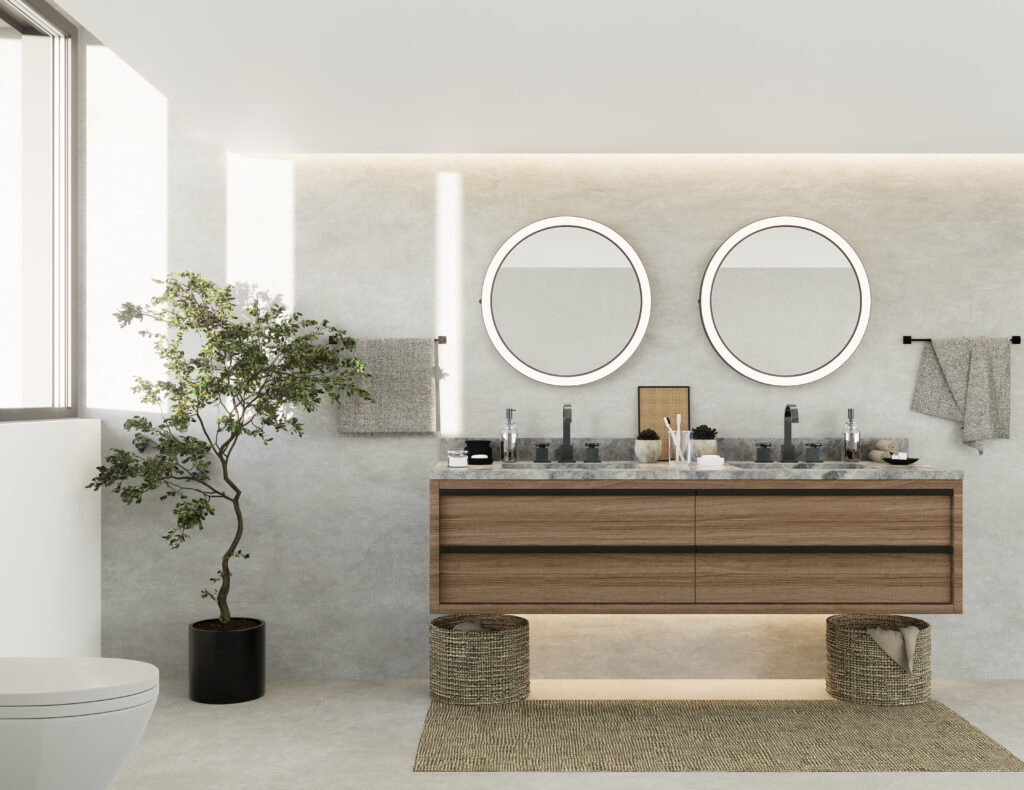
The circular wall light with integrated mirror represents one of the most sophisticated solutions for the washbasin area. Instead of superimposing mirror and luminaire as two independent elements, this typology merges them into a single piece that simplifies the visual composition of the wall and generates an enveloping perimeter light, without shadows, ideal for personal care tasks.
The TR Moon, designed by Josep Lluís Xuclà, is the ultimate expression of this philosophy. A perfect circle that integrates a mirror surrounded by a luminous halo of quiet elegance, becoming the compositional centre of the bathroom. On a technical level, it incorporates an integrated dimmer to regulate the light intensity, IP44 protection and an optional anti-fog system —a detail that guarantees impeccable performance even in moments of maximum condensation. It is a piece that does not only illuminate: it defines the identity of the space.
Orientable projectors: Precision and versatility in wet areas
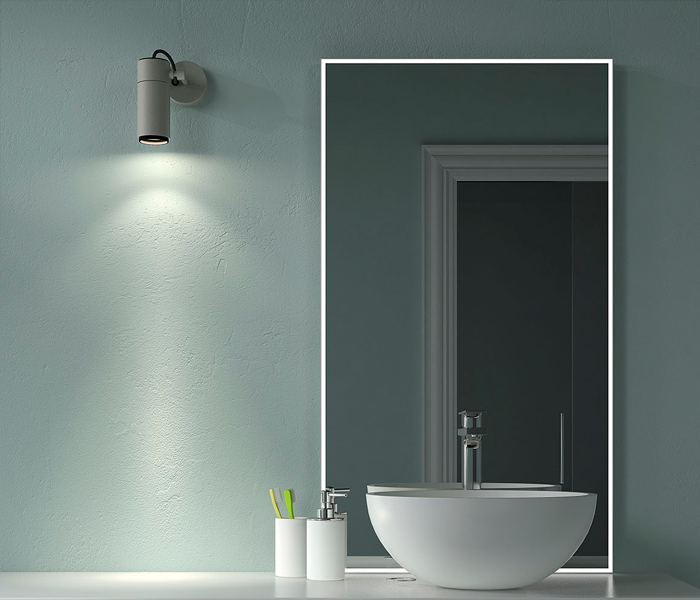
When the project requires accent lighting or the ability to direct the beam of light towards specific points —a singular wall covering, a freestanding bathtub, an architectural detail—, the orientable projector is the ideal tool. Unlike the diffuse light of the perimeter wall light, the projector sculpts the space with precision, creating visual hierarchies and areas of interest within the bathroom.
The Focus Line IP 44 responds to this need with a solution that does not give up on design. Manufactured in machined aluminium with matte anodised details, it incorporates a replaceable GU10 LED bulb that gives the specifier total freedom to customise the colour temperature and the beam angle according to the needs of the project. Available in white, black and champagne finishes, and with stem options of 5, 10 or 15 cm, it adapts to both surface installation and metal structures.
Colour temperature in the bathroom: The key to creating atmospheres of well-being
One of the most frequent mistakes when defining what type of lamp to use in the bathroom is to assume that this space needs a cold and clinical light. The belief that a colour temperature of 5000K or more provides a feeling of cleanliness is, in reality, a myth that leads to artificial and unwelcoming environments, far removed from the comfort experience that contemporary interior design seeks to convey.
The professional recommendation is to establish two complementary light registers. For the general lighting of the bathroom, a warm temperature between 2700K and 3000K transforms the space into a refuge of well-being with an enveloping effect reminiscent of spa environments. For specific tasks in front of the mirror —make-up, shaving, skin care—, a neutral light around 4000K reproduces skin tones more faithfully without altering colour perception. The combination of both layers, ideally dimmable, allows the user to transition between a functional early-morning bathroom and a space of nocturnal relaxation with a single gesture.
The colour rendering index: An invisible but essential parameter
Beyond colour temperature, there is a parameter that professionals must not overlook: the CRI (Colour Rendering Index). This value, which ranges from 0 to 100, measures the ability of a light source to faithfully reproduce the colours of objects compared to natural light. In the bathroom environment, where the human face is the main subject of observation, a CRI above 90 is essential to guarantee that skin tones, the nuances of make-up and the finishes of materials are perceived naturally. Specifying a luminaire with a lower CRI in the mirror area is equivalent to compromising the primary functionality of that point of light.
Where to place the light points in the bathroom: A zone-by-zone lighting strategy
The distribution of light points in the bathroom must respond to a considered strategy, not to the inertia of placing a central ceiling light and trusting that it will be enough. Each zone of the bathroom has different lighting needs, and the quality of the project lies in the ability to articulate them into a coherent scheme.
The mirror and washbasin area: Light without shadows
The most common mistake in this area is to place a single spotlight on the ceiling directly above the user’s head. This scheme casts hard shadows under the eyes, the nose and the neck, hindering any detailed task. The technically correct solution is to integrate the light into the perimeter of the mirror itself —exactly as the TR Moon does with its dimmable perimeter halo— or to flank the mirror with wall lights on both sides, at eye level, to create frontal, homogeneous and shadow-free lighting.
The shower and bathtub area: Safety and atmosphere
Water areas require luminaires with the appropriate IP protection —IP44 as a minimum in zone 2, IP65 or higher if there is a risk of direct contact with jets—, but that does not mean giving up on design. An orientable projector certified like the Focus Line IP 44 makes it possible to highlight the texture of a ceramic covering next to the shower or to illuminate a freestanding bathtub as a sculptural element of the space, all with the serenity that regulatory compliance provides.
General lighting: The canvas on which everything is built
The general light layer establishes the perceptual base of the space. It must be sufficient to guarantee visibility and safety, but contained enough not to flatten the lighting composition or compete with the accent sources. Diffuse ceiling lights, light lines integrated into the false ceiling or the combination of several projectors directed towards the walls to create indirect lighting are common strategies in high-level projects. The essential thing is that this layer functions as a neutral canvas on which the other layers —accent, task, decorative— can deploy their effect.
Materials and finishes: Durability as an expression of quality
In an environment subjected to constant cycles of humidity and temperature, the choice of the luminaire’s materials is as decisive as its optical performance. Unlike low-quality castings, machined aluminium offers a precision of finish and a superior durability that translates into exceptional resistance to corrosion. Matte anodising, present in pieces such as the Focus Line IP 44, provides an additional protective layer that preserves the integrity of the finish for years, while conferring that quiet elegance that defines the Insolit aesthetic.
Every luminaire we manufacture in our Barcelona workshop goes through machining, lacquering and assembly processes that meet high-level craftsmanship standards. It is not mass production: it is pieces designed to withstand the passage of time without losing their character, exactly like the architecture that houses them.
How to choose what type of lamp to use in the bathroom: Criteria for the specifier
For the professional who has to define the lighting of a bathroom project, the decision must be articulated around five fundamental axes. Firstly, the IP protection appropriate to each zone, as a non-negotiable safety condition. Secondly, the combination of layers of light —general, accent and task— to create a rich and functional lighting scheme. Thirdly, the colour temperature and its dimmability, which determine the versatility of the space throughout the day. Fourthly, the CRI of the LED sources, essential for colour fidelity in the mirror area. And finally, the quality of the materials and finishes, which guarantee the durability and aesthetic coherence of the luminaire with the rest of the project.
At Insolit, our collection of bathroom lamps designed & made in Barcelona offers solutions that satisfy each of these criteria without compromise. From the geometric elegance of the TR Moon to the architectural versatility of the Focus Line IP 44, each piece has been conceived to function as the natural answer to the demands of the most rigorous specifier. Because lighting a bathroom with criteria is not simply choosing a lamp: it is defining the experience of inhabiting that space every day.
Frequently asked questions about bathroom lighting
What type of lamp is most suitable for the bathroom?
There is no single answer: a well-lit bathroom combines several typologies. Wall lights next to the mirror resolve task light, orientable projectors provide accent light and ceiling or recessed points cover general lighting. The choice depends on the zone, its degree of humidity and the function of each point of light.
What IP protection should a bathroom luminaire have?
It depends on the zone. Zone 0 (inside the shower or bathtub) requires IP67; Zone 1 (above the shower or bathtub) a minimum of IP44, recommended IP65; and Zone 2 at least IP44. Outside these zones IP20 is admissible, although many specifiers opt for IP44 throughout the room.
What colour temperature is recommended for the bathroom?
For the mirror area, a neutral light around 4000 K is advised, guaranteeing colour fidelity for personal care. For ambient lighting, a warmer light (2700-3000 K) generates a relaxing atmosphere. Luminaires that are dimmable in temperature offer maximum versatility.
Conclusion
If you are developing a bathroom project and looking for luminaires that combine regulatory safety, technical performance and design, explore the bathroom lamps collection by Insolit.