 Skip to content

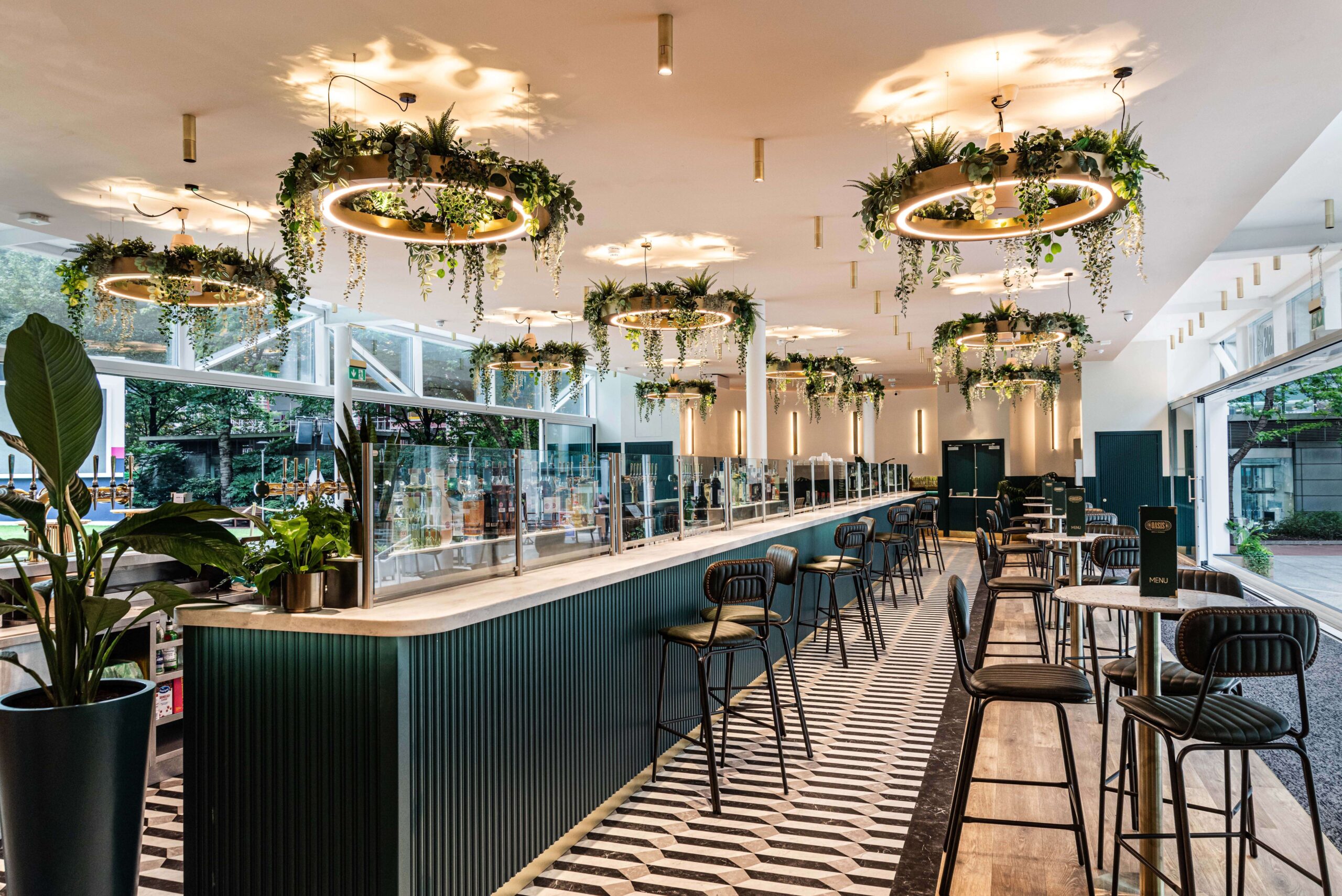
The lighting of a designer bar is not bought: it is designed. When a space is conceived as a complete sensory experience, light stops being a technical add-on and becomes another piece of the architectural language. The Oasis Bar & Terrace at Canary Wharf, in London, is a paradigmatic example of customised lighting applied to high-end hospitality: a project where Insolit developed specific luminaires to dialogue with the venue’s luxurious palette and reinforce its botanical identity.
Below we analyse how this case came about, what technical decisions shaped the result and what lessons can be applied to any project where light must add character to the space.
The context of the Oasis Bar & Terrace project
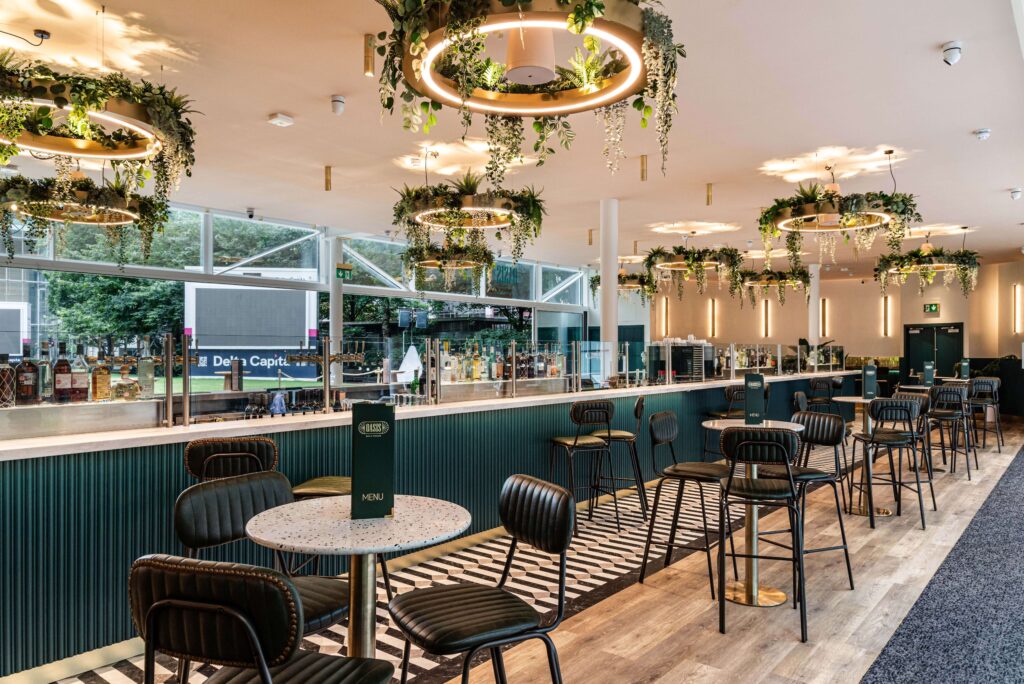
Located in London’s Canary Wharf financial district, Oasis Bar & Terrace is a venue conceived as an urban refuge: a green oasis in the middle of a corporate setting defined by glass and steel. The premise of the project revolved around a botanical aesthetic where vegetation built into planters takes the lead, accompanied by a luxurious palette with warm and gold tones.
The studio Givanni Associates led the architectural project, while Darklight Design was in charge of the lighting design. Insolit was brought in as the manufacturer to develop bespoke luminaires that could integrate with the visual logic of the space and, at the same time, meet the technical requirements of a professional bar: durability, high colour quality and easy maintenance. The project was completed in 2024 and photographed by Edmund Sumner.
The challenge: lighting without stealing the spotlight from the vegetation
The main technical challenge was to balance two functions that usually conflict: providing enough functional light for the bar to operate correctly and, at the same time, visually enhancing the vegetation without the luminaires competing with it.
The usual solution in these cases relies on discreet technical luminaires, downlights or recessed spots. But the creative team chose the opposite path: turn the luminaire into a sculptural object that dialogues with the planters as just another botanical element, both formally and conceptually.
Another major constraint was the finish: it had to be gold, not a standard metallic, to align with the luxurious interior palette. That ruled out any catalogue product and required developing a custom RAL finish specific to the project.
The technical solution: TR Spot & Up in an inverted version
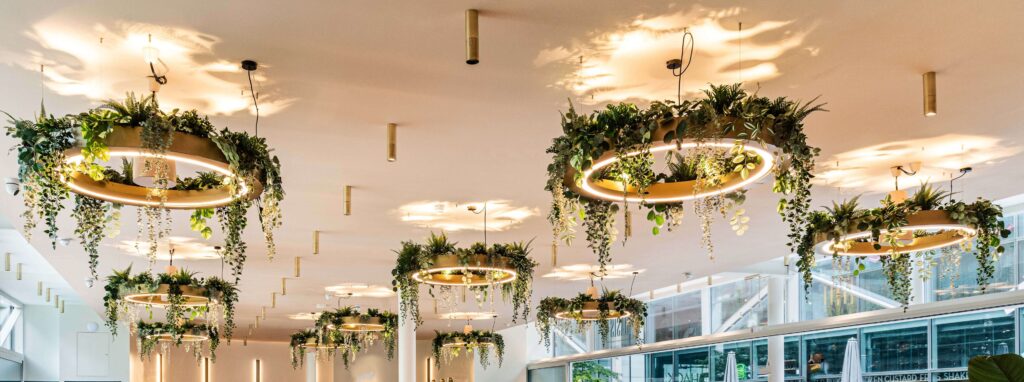
The piece chosen as the base was Insolit’s TR Spot & Up, a circular luminaire from the TR family originally designed as a pendant with dual emission: direct spot downwards and indirect light upwards that bounces off the ceiling. For Oasis Bar an inverted variation was developed that radically changes its behaviour:
- The main emission goes from pointing down to lighting upwards, generating a diffuse halo that wraps the vegetation.
- The Spot module is reoriented to create focal accents on the leaves and plants, mimicking sunlight filtering through the canopy.
- The custom RAL gold finish turns the luminaire into a decorative object when switched off, preventing it from looking like a piece of technical equipment.
Installation was carried out using tensor suspension, a solution that brings visual lightness and allows the height of each piece to be precisely adjusted to the ceiling and the level of the vegetation. The set is completed with ceiling discs in the same gold finish to neatly resolve the electrical supply and fixing.
Why it works: four key lighting-design decisions
Beyond the product itself, the success of the Oasis Bar project lies in a series of lighting-design decisions worth dissecting:
- Indirect light as an enveloping base. The main distribution of light points upwards and bounces from the ceiling, generating a soft wash that avoids harsh shadows. This technique is common in high-end hospitality projects because it reduces glare and provides a sustained sense of visual comfort.
- Targeted accents to create depth. The integrated spots bring the points of visual tension that prevent the atmosphere from falling into uniformity. They work as small brushstrokes of light that give rhythm to the visitor’s journey.
- Warm colour temperature (2700-3000 K). The choice of tone reinforces the welcoming feel typical of a night-time dining space and respects the natural colour of the vegetation.
- High CRI (over 90). Colour quality is essential when light falls on real plants: a low CRI would dull the greens and impoverish the proposal. Insolit’s luminaires are equipped with high-CRI LEDs designed for this kind of demand.
The collaboration between manufacturer, architect and lighting designer
A project of this level is only viable when the three main parties speak the same language from the start:
- Givanni Associates defined the spatial logic and the interior design.
- Darklight Design worked the lighting script (what is lit, with what intensity and temperature, at what times of day).
- Insolit developed the physical pieces that materialise that script.
This sequence is what distinguishes a custom project from a merely decorative one: every luminaire responds to prior reasoning. The typical process involves several rounds of finish samples, photometric tests and geometry adjustments before reaching the final product. At Insolit we accompany architecture and interior design studios along this path, offering bespoke development on consolidated product families such as TR, Stick, Plaque or Focus Line.
Frequently asked questions about customised lighting
What’s the difference between a custom luminaire and a catalogue one?
A custom luminaire starts from an existing product family (the mechanical base, the optical system, the electrical components) and is adapted in finish, geometry, dimensions or optical configuration. This allows it to be precisely tailored to a project without assuming the costs and timelines of developing a completely new product.
How long does it take to develop a customised luminaire like the ones at Oasis Bar?
It depends on the level of customisation. A RAL finish change can be resolved in four to six weeks. A more complex geometric variation, such as the inverted version of the TR Spot & Up, can take eight to twelve weeks including tests, prototypes and final validation.
Are TR family lamps suitable for terraces and outdoor use?
The TR family has specific versions for indoor use and others adapted to protected outdoor conditions. For exposed projects, it is necessary to verify the IP rating required by the location. At Oasis Bar the terrace is partially covered, which allowed indoor luminaires to be used with certain installation adaptations.
Conclusion: lighting as a tool of identity
The Oasis Bar & Terrace project shows that lighting, when approached as a design decision and not as a mere functional requirement, can completely transform the perception of a space. The combination of custom luminaires, careful installation and close collaboration between studios and manufacturer is what separates a correct bar from a memorable one.
If your next project needs a tailor-made lighting solution, explore our designer pendant lamps collection or get in touch with the Insolit team to discuss your case.