 Skip to content

Contemporary architecture has long ceased to regard the garden as a mere green companion to the building. Today, the outdoor space is a true extension of the architectural project—a place where materials, vegetation and light converge to construct atmospheres as deliberate as those of any interior. And yet, garden lighting remains, far too often, the final chapter of the project—when it should be one of the first.
Understanding how to light a designer garden means mastering a language that blends lighting technique, landscape sensibility and a deep knowledge of materials. It is not about flooding a planted surface with light, but about sculpting the night: revealing textures, creating depth, guiding the eye and, above all, respecting the identity of the landscape once the sun retreats.
Why Lighting a Designer Garden Is an Act of Architecture
There is a substantial difference between placing light points in a garden and designing the lighting of that garden. The former solves a functional problem—seeing where you walk. The latter transforms the outdoor space into an emotional setting that dialogues with the surrounding architecture, with the vegetation, with water, with stone.
For the architect or lighting designer, the nocturnal garden is a three-dimensional canvas on which light acts as a building material. Every beam defines a volume, every projected shadow generates depth, every intensity gradient establishes a visual hierarchy. To truly understand how to light a designer garden is to accept that light is, alongside vegetation, paving and furniture, the fourth pillar in the construction of outdoor space.
This conviction is what drives our work at Insòlit from Barcelona: designing and manufacturing luminaires that do not merely illuminate, but actively participate in the composition of the landscape. Luminaires that retain their character and beauty even when switched off.
Lighting Layers: How to Light a Designer Garden with Depth and Hierarchy
The most common mistake when approaching exterior lighting is thinking in terms of a single, general light source. Designer gardens—much like well-resolved interiors—operate with a system of superimposed lighting layers that, combined, produce a rich and adjustable atmosphere. Each layer serves a distinct function, and it is the intersection of all of them that delivers the complete visual experience.
Accent Light: Revealing What Matters
Accent light is the most powerful resource for creating drama and focusing attention. A concentrated beam directed at a tree canopy, the texture of a natural stone wall or a sculptural piece radically transforms the perception of the garden after dark. It is the layer that provides personality without overwhelming the space.
For this function, adjustable spotlights with precise optics are essential. The Focus Line family by Insòlit, designed by Jean-Michel Wilmotte, offers a comprehensive range of accent solutions for outdoor use. The Focus Line Spike model—a projector with a stainless steel AISI 316 spike for direct ground installation—allows you to illuminate vegetation, façades and focal elements with the precision a designer garden demands. Its machined aluminium body with a matt black anodised front ring and IP65 protection ensures resilience and a discreet aesthetic that blends seamlessly into the landscape.
For surface-mounted configurations—pergolas, perimeter walls, auxiliary structures—the Focus Line IP 65 offers three stem lengths (5, 10 and 15 cm) and even a version with a magnetic base (model 1411) that extends installation possibilities on metallic surfaces without drilling. Both models use a replaceable GU10 LED lamp, granting the specifier complete flexibility to adapt colour temperature and wattage to the specific requirements of each project.
Pathway Lighting: Guiding with Elegance
The second essential layer when lighting a designer garden is pathway illumination. Walkways, steps, pool edges, material transitions: all these elements need low, restrained lighting that guides the route without competing with the accent layer.
The Banus luminaire, designed by Jordi Mallorquí for Insòlit, is a paradigmatic example of how pathway lighting can be elevated to the level of signature design. Manufactured in machined and extruded aluminium with IP65 protection, the Banus integrates a 135° rotating micro-projector that allows millimetre-precise beam orientation. Its CRI of 90 ensures faithful colour rendition—a detail that makes all the difference when light interacts with the garden’s plant palette: greens, ochres, bark textures, floral tonalities.
The Banus is not merely a bollard: it is a lighting piece that delivers precise light and visual comfort, a discreet sculpture that dialogues with the landscape by day and reveals it by night.
Ambient and Floor Light: Setting the Overall Atmosphere
The third layer is the one that unifies the whole: a diffuse, enveloping light that sets the emotional tone of the garden. It does not seek the spotlight, yet its absence is instantly felt. It is the light that allows you to perceive the space in its entirety, that connects the garden’s different zones and generates that sense of In & Out continuity between indoors and outdoors.
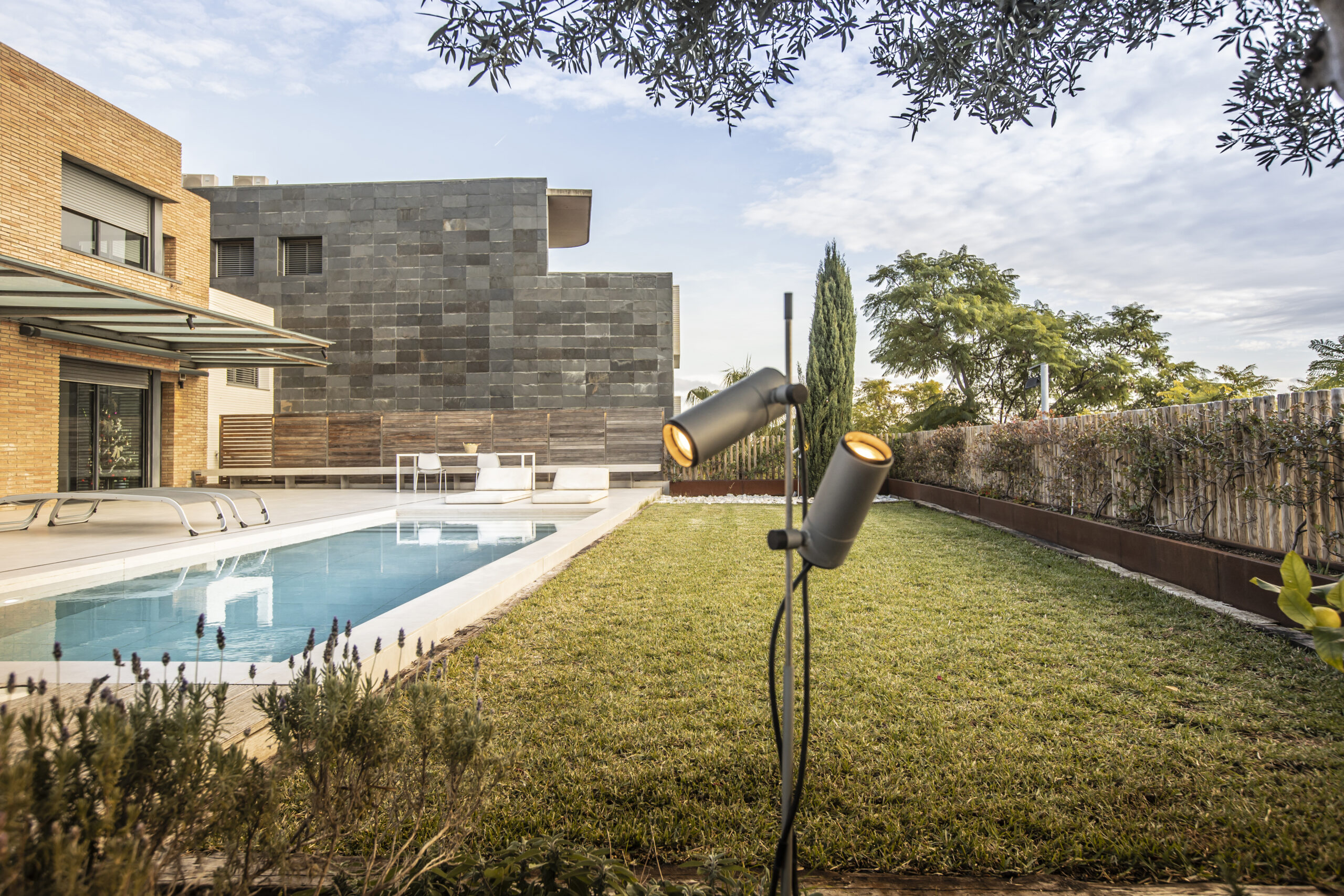
The Focus Line Floor IP 65 addresses this need with a floor-standing projector format—available in single and double versions—that combines the versatility of a repositionable light point with the robustness of the materials characteristic of the Wilmotte collection: machined aluminium, AISI 316 stainless steel support and IP65 protection. The double configuration proves especially effective in large gardens where illumination in two directions from a single anchor point is required.
Technical Criteria: How to Light a Designer Garden with Excellence
Beyond lighting composition, the specifier faces a set of technical decisions that will determine the durability, performance and aesthetic coherence of the project over the long term. These are the criteria we consider fundamental.
IP65 Protection: The Guarantee of Permanence
In outdoor environments, protection against dust and water is not optional: it is the first condition any garden luminaire must meet. The IP65 classification certifies total dust-tightness (6) and protection against water jets from any direction (5). Every Insòlit outdoor luminaire—Banus, Focus Line Spike, Focus Line IP 65 and Focus Line Floor IP 65—meets this standard, ensuring reliable performance against rain, irrigation systems and the most demanding weather conditions.
Colour Temperature and Colour Rendition: Fidelity to the Landscape
Choosing the right colour temperature is one of the most decisive factors when aiming to light a designer garden with purpose. Warm tones (2700 K – 3000 K) are generally the most suitable for residential exteriors: they respect the natural hues of the vegetation, create a welcoming atmosphere and reduce light pollution.
The use of replaceable GU10 LED lamps—as fitted in the Focus Line family—allows the professional to select the exact temperature and adjust wattage (up to 10 W) without replacing the entire luminaire. It is a design decision that prioritises product longevity and project flexibility.
A high colour rendering index (CRI)—such as the CRI 90 of the Banus—guarantees that the garden’s colours are perceived faithfully under artificial light: greens remain vivid, earthy tones preserve their warmth, flowers keep their nuance. This is vital in landscape lighting specification, where the interaction between light and plant matter defines the perceived quality of the whole.
Noble Materials: Machined Aluminium and Stainless Steel
Unlike the cast or injection-moulded plastic luminaires common on the market, Insòlit pieces are manufactured in machined aluminium—a process that delivers superior finish precision and durability—with structural elements in AISI 316 stainless steel, the benchmark alloy for environments exposed to moisture, salinity and atmospheric agents. The available finishes—white, black and champagne—with matt anodised treatment complete a palette designed to integrate discreetly into any landscape project.
Common Mistakes When Lighting a Designer Garden
Even in well-conceived projects, certain recurring errors compromise the final result. Identifying them in time is part of the specifier’s craft.
Over-illumination is perhaps the most prevalent: multiplying light sources without hierarchy flattens the space and eliminates shadows—which are, paradoxically, the very resource that generates depth and mystery in a nocturnal garden. Equally detrimental is chromatic uniformity: using a single colour temperature across the entire garden, without differentiating seating areas, pathways and planted elements, produces a visual monotony the eye perceives immediately.
Another frequent error is ignoring the garden’s temporal dimension. Vegetation grows, canopies broaden, hedges gain volume. A rigid lighting plan with fixed luminaires and no capacity for reorientation will become obsolete within a few years. This is precisely why adjustable spotlights—like the Focus Line range—and bollards with adjustable micro-projectors—like the Banus—prove indispensable, as they allow the beam direction to adapt to the natural evolution of the landscape.
Finally, cutting corners on material quality in outdoor luminaires is a decision that exacts a swift price. The elements are unforgiving: corrosion, UV degradation and water ingress condemn low-quality luminaires to a short lifespan and a deteriorated appearance that compromises the garden’s aesthetics long before anticipated.
How to Light a Designer Garden: A View from the Workshop
Lighting a designer garden is not an exercise in quantity, but in intention. Every luminaire must answer a precise question: what do I wish to reveal? What do I wish to suggest? What do I prefer to leave in shadow? It is in that dialogue between light and darkness that the true atmosphere of a nocturnal garden is born.
From our workshop in Barcelona, we conceive every piece as a precision instrument at the specifier’s service: machined aluminium luminaires with IP65 protection, designed by figures such as Jean-Michel Wilmotte and Jordi Mallorquí, manufactured with the obsessive attention to detail that defines high-level craftsmanship. Because a designer garden deserves luminaires that are equal to the landscape they illuminate—and that preserve their quiet elegance year after year, season after season.
If your project calls for an outdoor lighting solution that combines technical rigour with aesthetic sensibility, our team is ready to accompany you from the specification phase through to final delivery. We design, we manufacture and we customise: it is what defines us.