 Skip to content


A picture light should allow an artwork to be seen clearly, without distracting reflections or shadows that obscure its details. When choosing one, consider the size of the picture, the depth of its frame, its surface finish and the positions from which it will be viewed.
The choice also forms part of the interior design. A light positioned above the frame becomes part of the wall composition, while a ceiling spotlight creates visual separation between the lighting and the artwork. Both approaches can work, provided the light distribution suits the picture’s format and position.
What to consider when choosing a picture light
Before deciding on the finish or shape of the luminaire, establish what it needs to illuminate and from where.
| Criterion | What to check |
| Artwork dimensions | The light should reach the area you want to highlight without leaving excessively dark patches. |
| Frame depth | The upper edge should not cast a distracting shadow across the image. |
| Glass or glossy surfaces | The light source should not appear as a reflection from normal viewing positions. |
| Colour rendering | The light source should allow the colours to be appreciated accurately. |
| Adjustability and optics | The beam should suit the artwork’s format and the lighting distance. |
| Power supply and controls | The planned installation and dimming system should be compatible with the selected model. |
Light that reveals the colours
The colour rendering index, or CRI, helps assess how a light source renders colours. For lighting art, look for LEDs with high colour rendering, using values above 90 as a quality reference.
This specification must be checked for the actual light source. In a luminaire with a replaceable lamp, colour rendering depends on the lamp fitted.
A beam suited to the format
A small artwork and a large composition have different lighting requirements. The beam angle and the distance from the luminaire determine the area that receives light.
Narrow beams can highlight smaller pieces or illuminate from greater distances. Wider distributions help cover larger surfaces. When the artworks on display change, suitable adjustment and optics make it easier to adapt the lighting.
A picture light above the frame or lighting from the ceiling?
A picture light mounted above the frame creates a direct visual relationship with the artwork. It can be a suitable option when the picture has a fixed position and the luminaire is intended to become part of the composition.
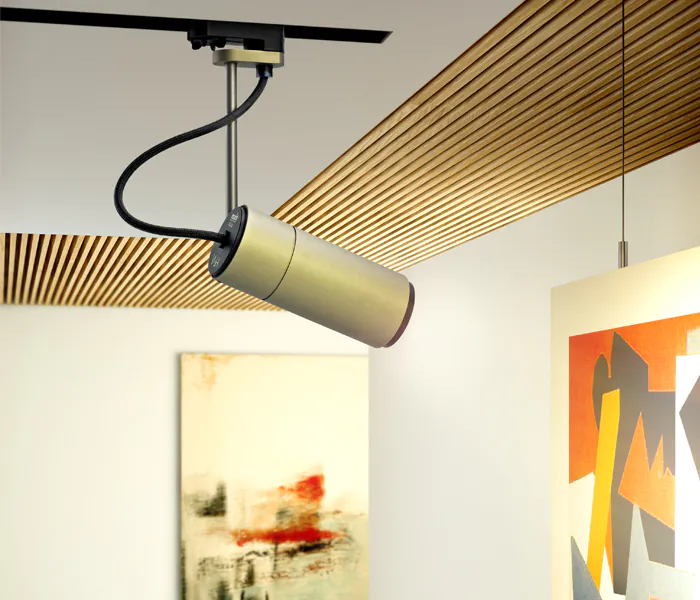
Ceiling lighting offers a different approach: the artwork retains its presence on the wall, while the light comes from another plane. Adjustable spotlights allow light to be directed towards a particular piece; track systems make repositioning easier when a collection is rearranged.
If the aim is to illuminate a wall displaying several artworks evenly, wallwashing can also be considered. Its effect differs from lighting each picture individually: it brings the display together rather than creating a separate accent on each piece.
How to avoid reflections and shadows on a picture
The positioning should be checked from the places where the artwork will be viewed. In a living room, for example, it is useful to assess the result both standing up and sitting on the sofa.
For ceiling spotlights, a common starting point is to direct the light at an angle of approximately 30° from the vertical. This helps manage shadows cast by the frame and the viewer, as well as reflections on glazed surfaces.
The final position requires adjustment according to the ceiling height, frame and artwork’s finish. The 30° rule should not automatically be applied to every picture light mounted above a frame.
Before fixing the luminaire in place, check:
- Whether the frame darkens the upper part of the image.
- Whether reflections appear as you move around the room.
- Whether the light reveals details without exaggerating textures.
- Whether the viewer casts a shadow onto the picture.
Focus Line Track: adjustable lighting to highlight artworks
While a picture light can be a good solution for an artwork with a fixed position, ceiling lighting is also worth considering. When the aim is to keep the wall clear or adapt the lighting positions to different arrangements, an adjustable track spotlight offers greater flexibility.
Focus Line Track by Insolit provides a solution for lighting pictures from the ceiling while keeping luminaires off the wall. Designed by Jean-Michel Wilmotte, this adjustable spotlight is made from machined aluminium and designed for installation on three-circuit track with a replaceable GU10 LED lamp.
Its installation allows lighting points to be moved along the track and the spotlights to be aimed towards the artworks. This flexibility is particularly useful when a wall arrangement changes or new pieces are added, provided the track’s location allows their new positions to be illuminated.
To specify the solution, choose a lamp with high colour rendering and a beam angle suited to the picture’s size and the lighting distance. The aiming should also be checked from normal viewing positions, particularly when the artwork includes glass or glossy surfaces.
With carefully considered positioning, Focus Line Track can provide accent lighting that gives artworks prominence while integrating with the architecture of the space.

Plan your picture lighting with Insolit
Choosing a luminaire starts with understanding the artwork and its relationship with the space. Its dimensions, frame, viewing positions and available electrical connections help establish which solution to explore.
If you are developing a residential, hotel or commercial project, contact Insolit and share photographs, dimensions and plans. You can discuss the available collections and the feasibility of a solution adapted to your project’s requirements.
Frequently asked questions about picture lighting
LED lighting with high colour rendering, a distribution suited to the artwork’s format and an orientation that controls reflections and shadows. The quality of the source, the optics and the luminaire’s position should be assessed together.
For sensitive artworks, light levels and exposure time must also be defined. Using LEDs does not completely eliminate the risk of light damage.
First, identify the artwork’s size, its finish and the positions from which it will be viewed. Then choose between a picture light above the frame, a wall spotlight or a ceiling solution.
Test the aiming before finalising the installation. The result should allow the artwork to be appreciated without the frame, glass or luminaire interfering with the view.
If you need a solution without a permanent electrical connection, consider a dedicated picture light powered by rechargeable or replaceable batteries. Before choosing one, check its operating time at the intended brightness, its colour rendering and how easy it is to recharge or replace the batteries.
If the aim is simply to keep cables out of sight, concealed wiring offers another option, although the electrical connection must be planned. A clamp or magnetic mounting system does not mean that a luminaire operates without a cable.
Use adjustable surface-mounted, recessed or track spotlights, selected according to the conditions of the space. Their position should allow the beam to be directed towards the artwork and matched to its dimensions.
As an initial reference, consider an angle of approximately 30° from the vertical, then check the result from the viewing positions.
There is no universal mounting height. It depends on the picture’s position, the depth of the frame, the projection of the arm and the light distribution.
The distance above the upper edge should allow the surface to be illuminated without creating a band of shadow. It is preferable to test the effect with the selected model before fixing the electrical connection point.
Yes. Cumulative exposure to light can affect sensitive materials and colours. Avoid direct sunlight and adjust both the light level and the hours of operation.
For valuable artworks or delicate materials, exposure requirements should be agreed with a conservation specialist.