 Skip to content

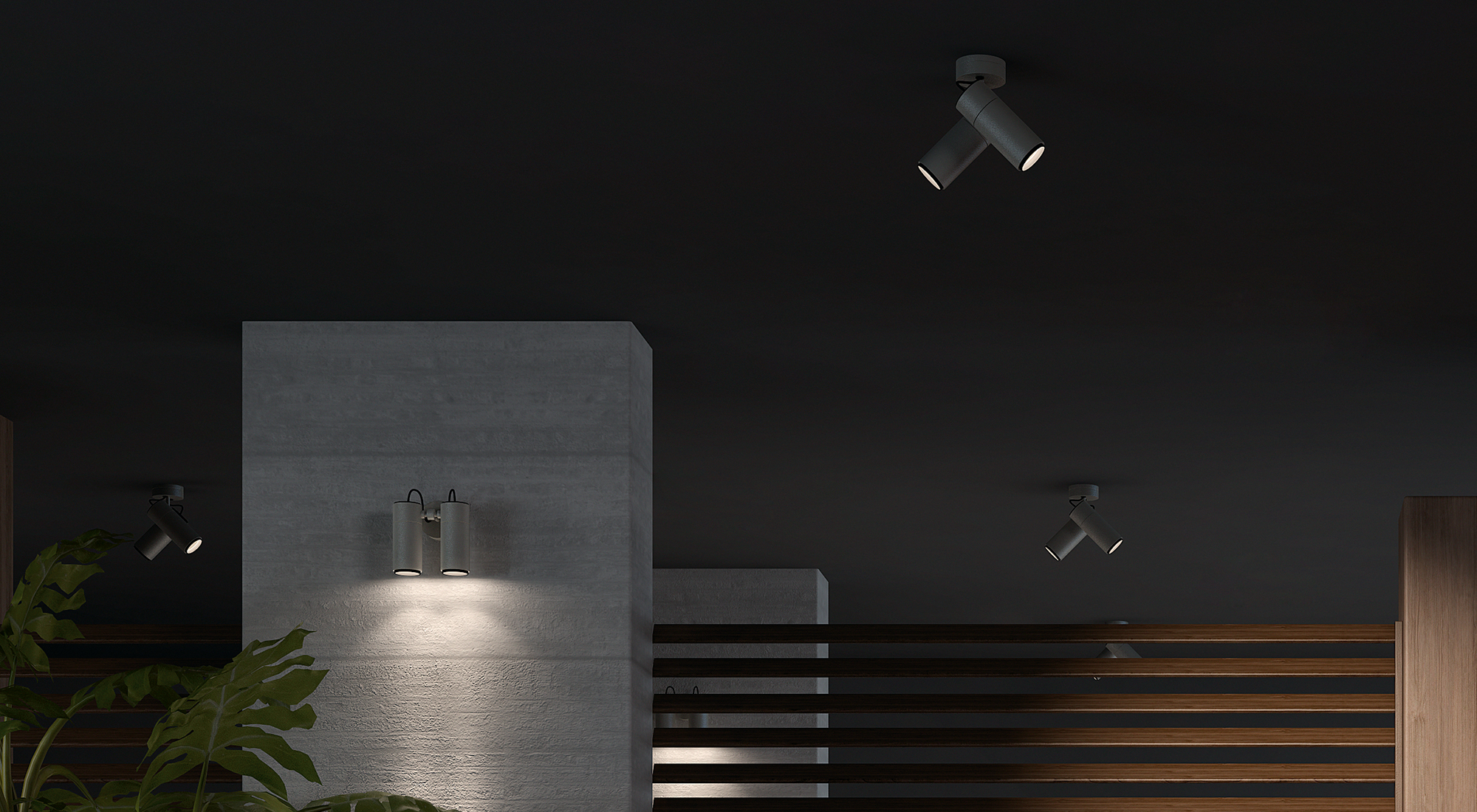
Choosing between the different types of outdoor luminaires is one of the decisions that most shapes the outcome of an outdoor lighting project. It isn’t only about providing light: each family of fixture fulfils a specific role — to guide, to highlight, to set a mood — and meets different technical requirements. In this guide we go through the main types of outdoor luminaire, what each one brings and how to combine them to build a coherent lighting scheme.
How outdoor luminaires are classified
Outdoor luminaires can be classified in several ways: by their lighting function (accent, path marking, ambient), by their installation type (recessed, on a post, surface-mounted) or by their degree of protection against the elements. In practice, the specifier combines these criteria to select the right piece for each point of the project.
What they all share is resilience: an outdoor luminaire must guarantee an adequate IP rating — usually IP65 — and use materials capable of withstanding humidity, UV radiation and temperature changes without degrading.
Path-marking luminaires
Path marking is the light that signals routes: paths, steps, accesses or the perimeter of an area. Its purpose is to guide without dazzling, so these are low-height fixtures with light controlled downwards.
The Banus luminaire is an example of path marking understood as a design piece: it fulfils the function of guiding the way with a refined aesthetic. Its Banus Twice version adds dual emission to illuminate both sides of a route.
Projectors and accent luminaires
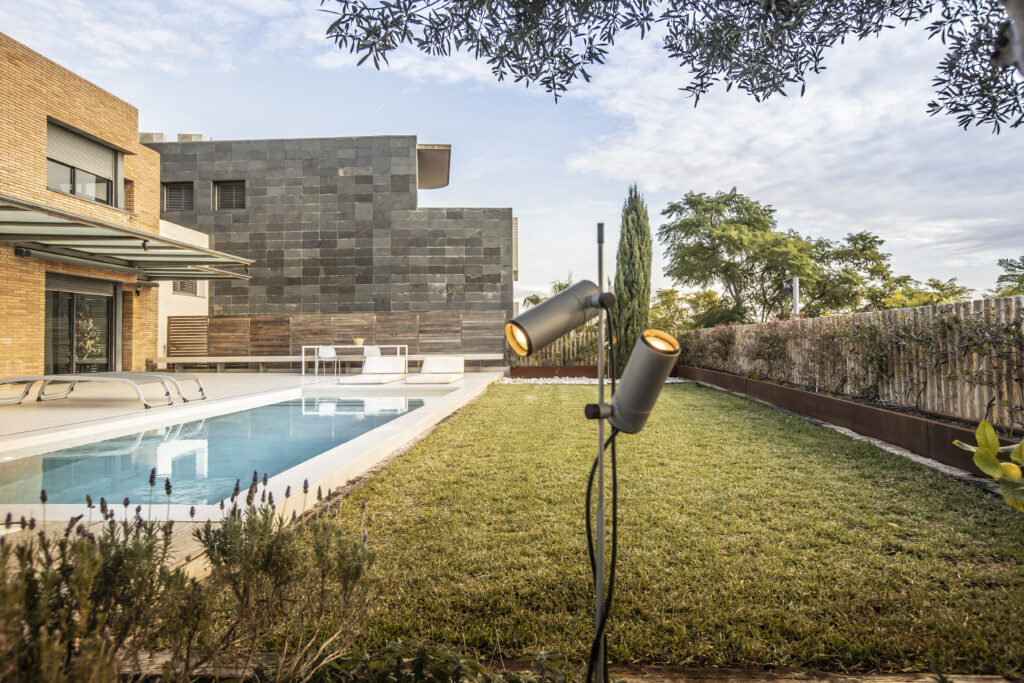
Projectors are luminaires used to highlight specific elements: a tree, a sculpture, a façade or a textured wall. They let you direct a precise beam and grade the intensity to create points of visual tension in the nocturnal landscape.
The Focus Line family offers a wide range of adjustable outdoor projectors. The Focus Line Spike, with a stake anchor, lets you light vegetation by planting the fixture directly into the ground, while the Focus Line Double IP 65 integrates dual optics to light two directions from a single point.
Outdoor wall sconces
Wall sconces resolve the lighting of façades, accesses and perimeter walls. Depending on their optics they can produce a downward, upward or dual beam, letting you play with light on the wall surface and create graphic effects.
For this function a high protection rating is essential. Solutions such as the Focus Line IP 65 let you resolve the outdoor sconce with an architectural aesthetic consistent with the rest of the project.
Outdoor floor and portable luminaires
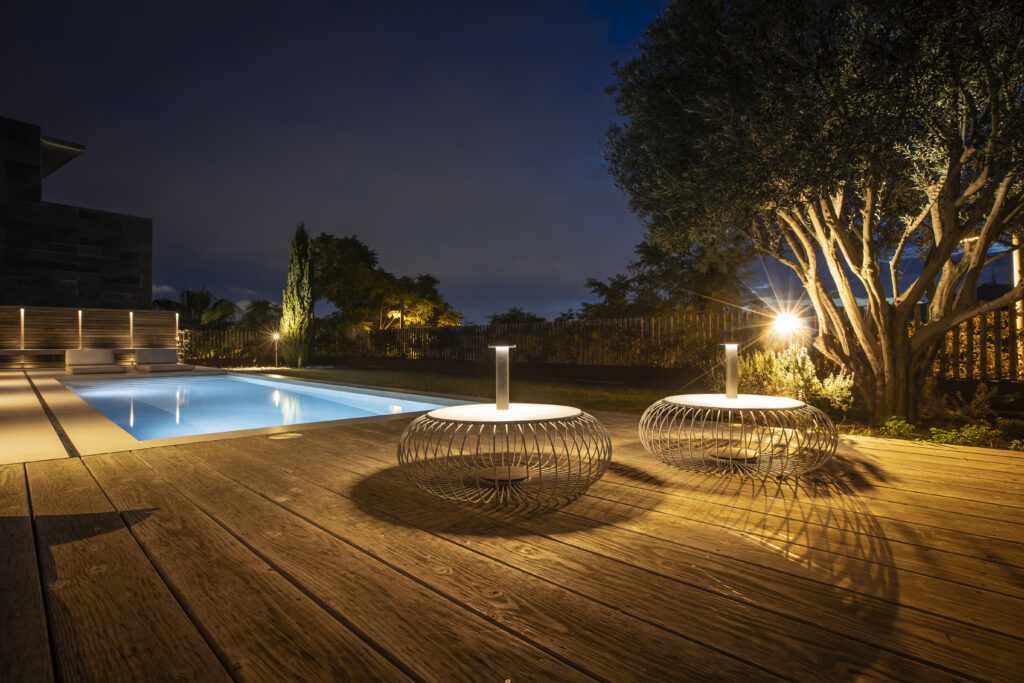
The ambient lighting of seating areas — terraces, porches, outdoor dining areas — is resolved with floor lamps and, increasingly, with rechargeable portable lamps. The latter respond to the “nomadic” trend: cable-free pieces that move freely around the space.
Models such as Basic or LC bring table and ambient light to any outdoor spot, without depending on a fixed electrical installation.
Recessed and floor luminaires
Recessed floor or pavement luminaires deliver a discreet, integrated lighting. They are used to light façades upwards, mark architectural lines or create path marking without any visible vertical elements. They require a high protection rating because of their exposure to water and footfall.
Materials and finishes: the key to durability
In an outdoor luminaire, the material is not an aesthetic detail: it determines how many years it will keep its look and its performance. Outdoor exposure subjects fixtures to constant wear — humidity, UV radiation, salt in coastal environments, hot–cold cycles — that only quality materials can resist without degrading.
Machined aluminium is one of the reference materials for high-end outdoor luminaires: lightweight, corrosion-resistant and with excellent thermal dissipation, which extends the LED’s lifespan. Anodised treatment adds a protective layer that preserves the finish for years. Stainless steel, in turn, brings exceptional resistance in the most demanding environments, such as areas close to the sea.
By contrast, low-quality luminaires — with fragile plastics or poor alloys — degrade quickly: they lose their watertightness, fade and end up compromising the project’s aesthetics much sooner than expected. Investing in materials is, in fact, investing in the permanence of the project.
Colour temperature in outdoor luminaires
Regardless of the type of luminaire, colour temperature is a decisive parameter in the final result. Outdoors, warm temperatures are the most advisable: a light of 3000 K offers a versatile warm white that enhances vegetation and defines architecture well, while 2700 K brings a more intimate, welcoming atmosphere, ideal for terraces and lounging areas.
Cool light (4000 K or above) should be avoided in residential and hospitality projects: it creates an artificial atmosphere, robs the landscape of warmth and contributes to light pollution. Keeping a consistent colour temperature across all the project’s luminaires is also essential for a coherent result.
How to choose the type of luminaire by zone
A well-resolved project doesn’t depend on a single type of luminaire but on the smart combination of several. As a general rule:
- Paths and steps: path-marking luminaires.
- Trees, sculptures and façades: accent projectors.
- Walls and accesses: outdoor wall sconces.
- Terraces and seating areas: floor and portable luminaires.
- Architectural integration: recessed floor luminaires.
The key is to work in layers and reserve each type of luminaire for the function it performs best, avoiding over-lighting.
Frequently asked questions about types of outdoor luminaires
How many types of outdoor luminaires are there?
The main types are path-marking luminaires, accent projectors, wall sconces, floor and portable lamps, and recessed floor luminaires. Each one fulfils a different function within the lighting scheme.
What IP rating should an outdoor luminaire have?
The recommended standard for outdoors is IP65, which guarantees full protection against dust and resistance to water jets. For recessed floor luminaires or highly exposed fixtures, higher ratings should be considered.
Can several types of luminaires be combined in the same project?
Not only can they be combined — it is the recommended approach. A quality project works in layers, assigning to each type of luminaire the function it performs best — path marking, accent or ambient — to build a rich and balanced scheme.
Conclusion
Knowing the different types of outdoor luminaires is the first step in designing a coherent, lasting outdoor lighting scheme. The combination of path marking, accent, sconces and ambient light, always with the right IP protection, is what sets a professional project apart. Discover all the options in the Insolit outdoor lamps collection.