 Skip to content

When we talk about wall lamps, the first image that comes to mind is usually a luminaire that emits light in a single direction: either it lights upwards to create ambience, or it projects downwards to mark a specific point. There is a third way, technically more sophisticated and visually more interesting: up & down wall lamps.
This type of luminaire emits light simultaneously upwards and downwards, generating a double beam on the wall that completely changes the reading of the space. It is not just a functional solution: it is an architectural resource that architects and interior designers are increasingly using to bring drama, depth and rhythm to hallways, lobbies and transition areas.
In this article we explain exactly what an up & down sconce is, what advantages it brings to an interior design project, where it works best and which Insolit models resolve it with design intent.
What is an up and down wall lamp
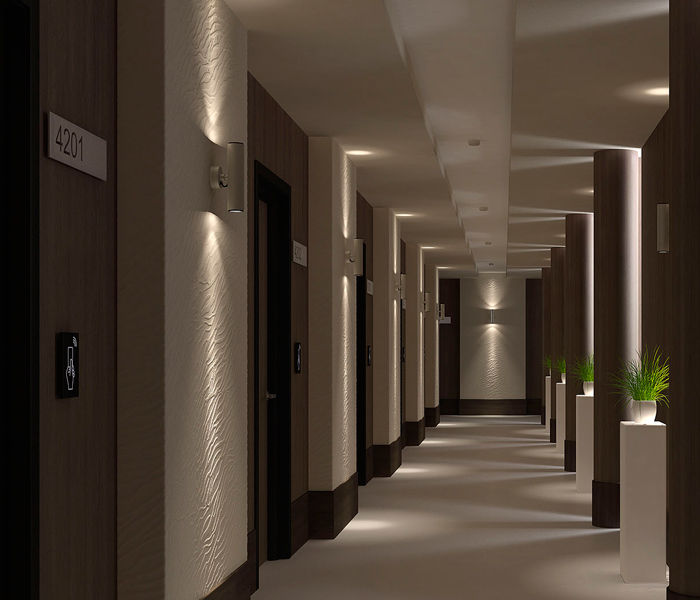
An up & down wall lamp (also called dual-emission or bidirectional sconce) is a wall luminaire that projects light simultaneously in two opposite directions: towards the ceiling (upward emission, “up”) and towards the floor (downward emission, “down”).
Mechanically, this is resolved in two ways: with two independent light sources integrated in the same casing, or with an optic that splits the beam into two opposite streams. In either case, the visual effect on the wall is very recognisable: two symmetrical cones of light that draw a luminous column on the wall, leaving the sides in shadow and reinforcing the vertical character of the space.
Unlike a conventional sconce, which distributes light in a single direction and leaves a single pattern on the wall, the up & down creates a play of symmetry that brings visual dynamism without resorting to bulky or showy pieces. The luminaire disappears aesthetically; what remains is the drawing of the light.
Advantages of up & down sconces in interior design
The advantages of this kind of optic explain why it is a regular resource in hospitality and contemporary architecture projects.
The first is making the most of the wall as an active surface. By lighting the wall rather than the surroundings, the light doesn’t project onto the eyes of the person passing: it bounces softly off the ceiling and the floor, generating an indirect wash that avoids glare and brings visual comfort even at high lighting levels.
The second is controlled drama. The contrast between the two illuminated cones of light and the rest of the wall in shadow generates a very powerful visual hierarchy. In a long hallway, a series of up & down sconces spaced rhythmically turns a functional path into an architectural experience.
The third is installation versatility. As it concentrates all the photometry in two well-defined directions, the up & down sconce works both in residential and contract, indoors and — with the right IP rating — also on façades and outdoors.
Finally, there is a less obvious but important advantage: saving on fixtures. A single up & down luminaire covers two lighting functions (upward and downward accent) that would otherwise require two independent sconces. This simplifies the electrical installation and reduces the sense of visual saturation.
Where to place up & down sconces
Not all spaces get the same value from this typology. These are the locations where the up & down sconce shines.
In hallways, especially long or narrow ones, a series of up & down sconces at regular intervals (every 1.5-2 m) marks the rhythm of the path and provides ambient light without the need for ceiling installation. It is one of the most widely used resources in boutique hotels.
In lobbies and entrances, a pair of up & down sconces framing a door or a central mirror creates a symmetrical composition that brings presence and welcome to the space.
In bedrooms, an up & down sconce over the headboard works as a decorative piece and, at the same time, provides indirect light for a restful atmosphere. For a double function — ambience plus focused reading — models such as Insolit’s Spy resolve both with a single piece.
On staircases, up & down sconces mark the ascent elegantly and bring safety without visual saturation. And on interior or exterior façades with IP65 protection, they are a common solution for giving architectural character to the building.
3 Insolit up & down wall sconces
In our collection you will find three models that resolve the up & down optic from different formal and technical languages. Each one responds to a different type of project.
Focus Line Wall Double: dual emission with Wilmotte’s signature
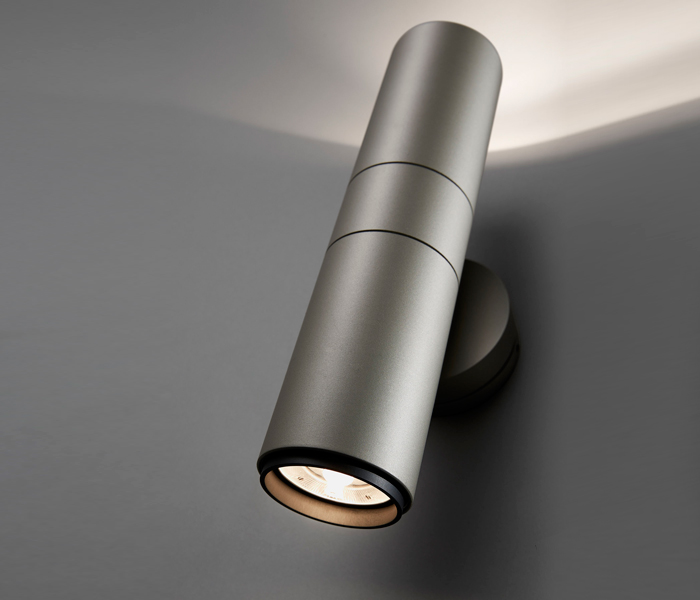
The Focus Line Wall Double is the up & down sconce par excellence of Insolit. Designed by the French architect Jean-Michel Wilmotte, it is a double wall projector in machined aluminium that takes replaceable GU10 LED bulbs. Each of its two heads can be oriented independently, which lets you precisely adjust the angle of the upper and lower beam according to the project’s needs.
Its matte black anodised finish (front ring and rear cap) and the black fabric cable give it that discreet and refined character that defines Wilmotte’s signature. It works exceptionally well in repeated compositions in hotel hallways, at restaurant entrances and in contract projects where visual coherence must hold across many metres.
Its great advantage: by using replaceable GU10 bulbs, the specifier can choose the exact colour temperature and beam angle for each space, while making long-term maintenance easier.
Spy: dual function for headboards and reading areas
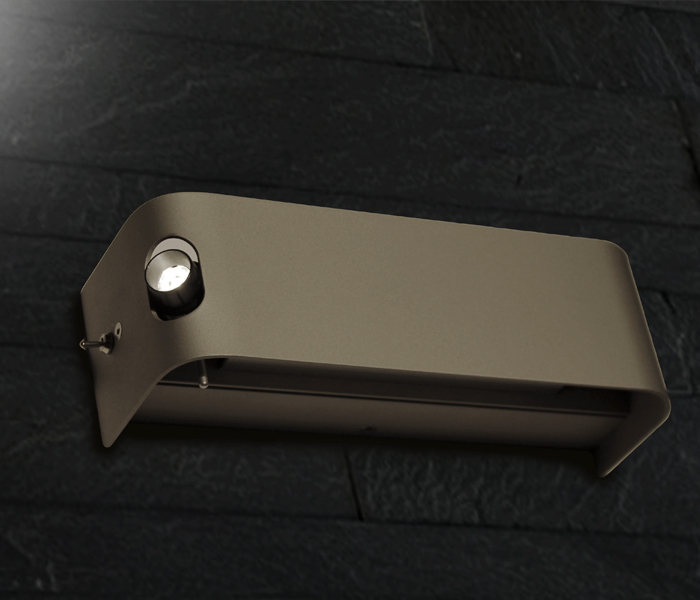
The Spy is Insolit’s proposal when the wall sconce must fulfil two differentiated functions: direct reading light through an adjustable projector and general indirect light that washes the wall. It is, in a broad sense, a sconce with functional up & down logic: one source for task, another for ambience.
The reading head is made of machined aluminium and the body of extruded aluminium, with an extruded matte polycarbonate diffuser and a lacquered aluminium shade. Its three-position switch (on-off-on) allows you to independently activate each of the two light sources: reading only, ambience only or both at once.
It is the ideal piece for bed headboards — especially in hotel projects, where it resolves the room lighting in a single luminaire — and for reading corners in libraries or living rooms.
Plaqué: dual emission with sculptural intent
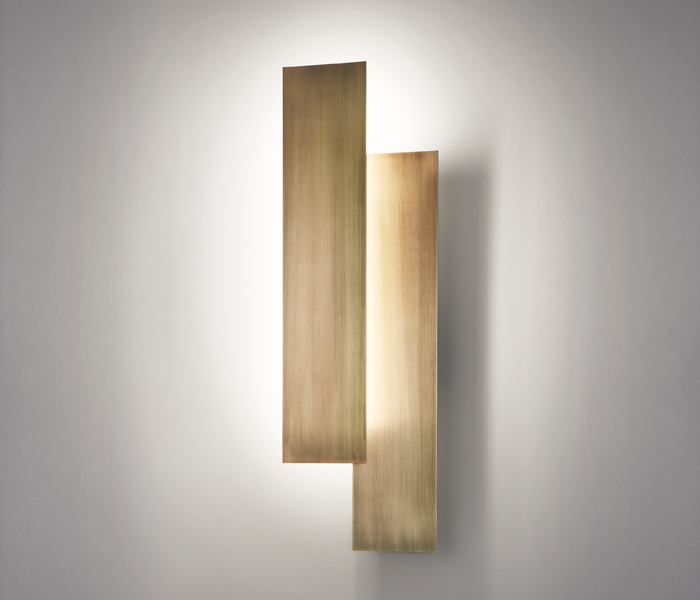
The Plaqué approaches dual emission from a different angle: instead of two separate directional beams, it projects an enveloping indirect light that bounces both upwards and downwards from its main shade. The result is a soft and ambient light, with no harsh contrasts, that dresses the wall with elegance.
Its main differential is its modularity: the Plaqué collection proposes two additional shades — 60 and 30 mm deep — without a light source, that can be added around the main luminaire to create unique compositions of light and shadow. This turns every installation into a different piece, adapted to the project’s language.
Made from aluminium with a polycarbonate gel diffuser and dimmable LED light via integrated base dimmer, it is the ideal option for projects where the sconce must also function as a decorative object with character, both in high-end residential and in designer hospitality.
How to choose the right up & down sconce
There are three parameters that should be resolved before specifying an up & down sconce in a project.
The first is the installation height. As a general reference, ambient sconces sit between 1.6 and 1.8 m from the floor; up & down sconces for staircases or hallways can be lowered slightly so the upper cone reaches the ceiling cleanly, without being interrupted.
The second is the spacing between pieces. In hallways, the recommended distance between up & down sconces is between 1.5 and 2.5 m, depending on the power of each piece, the ceiling height and the desired effect. Closer together generates an intense rhythm; further apart, a more sober atmosphere.
The third is the colour temperature. For residential and hospitality areas, we always recommend a warm light of 2700-3000 K. A cooler light would reduce comfort and break the atmosphere. And, in any case, a CRI above 90 is essential so the wall colours and the surrounding materials are reproduced faithfully.
If you want to dive deeper into how to combine light layers, we recommend our guide on applications of indirect light in interior design.
Common mistakes when installing up & down sconces
Although they seem easy to install, there are several recurring mistakes worth avoiding.
The first is placing them too close to the ceiling. If the sconce is less than 30-40 cm from the ceiling, the upper cone flattens onto the plane and loses the characteristic vertical wash effect. It needs air above to deploy its drawing.
The second is choosing a cold temperature. It works technically, but it ruins the atmospheric effect. The up & down sconce lives on the warmth of reflected light; with cool light it becomes clinical.
The third is unbalancing the power between the two beams. The charm of the up & down is in the visual symmetry. If the lower light is much more powerful than the upper one (or the other way around), the drawing becomes unbalanced and loses its graphic character.
Frequently asked questions about up & down wall sconces
What is an up and down wall sconce?
It is a wall luminaire that emits light simultaneously upwards and downwards, generating a symmetrical double beam on the wall. It is used both for its functional value — it bathes the wall with indirect light without glare — and for its decorative and architectural effect.
Where are up & down sconces recommended?
The most common locations are long hallways, lobbies, staircases, bedrooms and interior or exterior façades. In hallways they are usually installed in series, spaced between 1.5 and 2.5 m; in bedrooms they work well over the headboard combining ambience and reading.
At what height should an up & down sconce be installed?
The general reference is between 1.6 and 1.8 m from the floor for ambient sconces. It pays to leave at least 30-40 cm free above the sconce so the upper beam can deploy properly across the ceiling without flattening.
Discover all wall lighting solutions in the Insolit wall lamps collection.