 Skip to content

There is a moment in every interior project when a space stops being a sum of surfaces and starts having character. More often than not, it coincides with the choice of the pendant lamp.
It is the only lighting piece that comes down from the ceiling to sit at eye level. It occupies the air, the most overlooked material in a home, and makes it visible. Switched on, it decides where people look and where they talk. Switched off, it remains an object: a suspended sculpture in dialogue with the table, the sofa, the architecture.
This guide gathers the decisions that recur in every project: which types of suspended fitting exist, how to size them, how high to hang them and which mistakes to avoid. For room-by-room detail, the dedicated guides for the living room, bedroom and dining room are linked further down.
Why a pendant changes an entire room
A ceiling plate or a downlight solves general lighting, but spreads it from a flat, anonymous plane. A pendant does something else: it brings the light source down and, in doing so, reorders the space.
- Functional, directed light. Shortening the distance between source and surface improves visual comfort and needs less power for the same result.
- Zoning. In open-plan spaces, a pendant above a table or an island says “this is where we eat” without raising a single partition.
- Decorative value. The body of the fitting is fully visible, so its design matters as much as its photometric performance.
The trade-off is that it demands judgement. A badly sized pendant, or one hung at the wrong height, unbalances the whole room, however good the piece.
Types of pendant lamps: four ways of occupying the air
Each format answers a different intention. These are the four families most used in residential and contract projects:
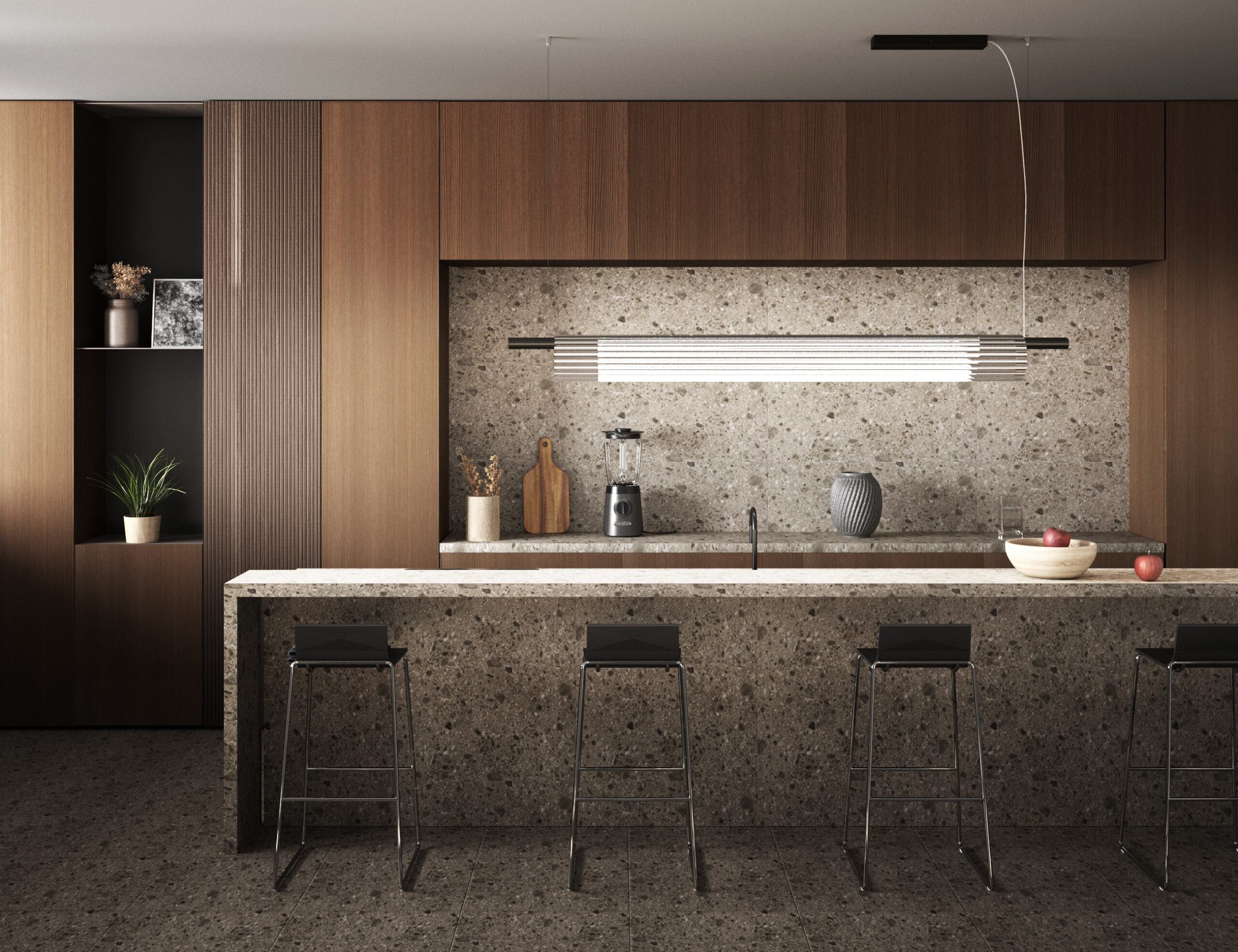
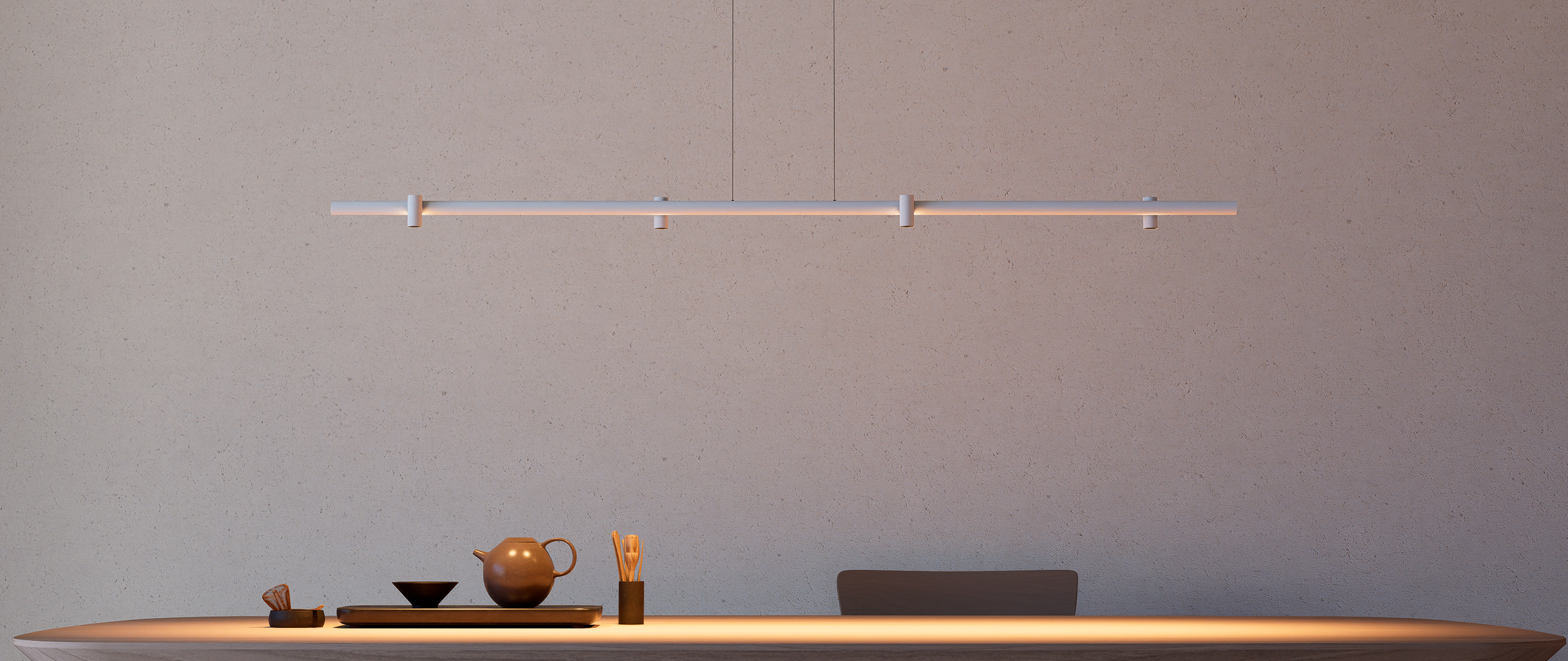
1. Linear pendants. A long stroke over rectangular tables, bars and kitchen islands. It is the most efficient way to light a long surface without repeating light points. Gravity, a 25 mm tube with integrated adjustable spotlights, takes the idea to its limit: a minimal line in the air, with every beam aimed independently.
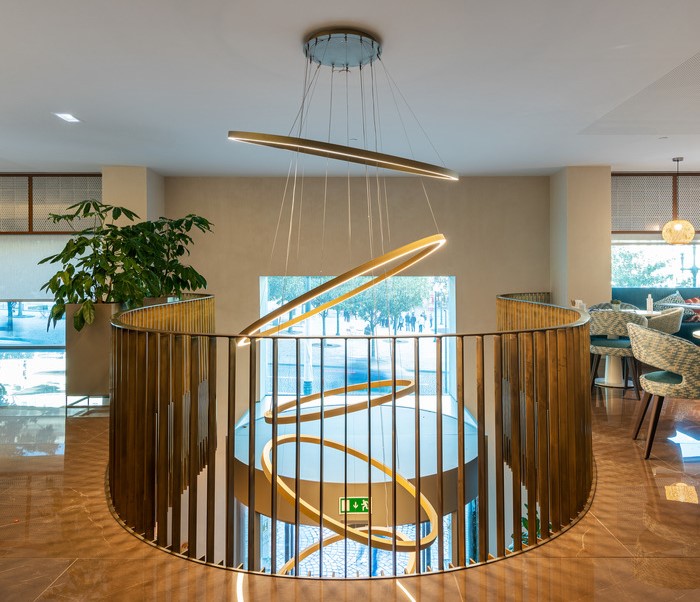
2. Circular pendants. The suspended ring, with downward, upward or mixed light. It is the most generous geometry: an enveloping clarity with no hard edges. The TR family is its most refined expression, with versions such as the TR Air, hung from the finest tension wires and appearing to float, or the TR Huge, which scales the same circle into an architectural statement.
3. Spot or single-point pendants. One concentrated source for accent lighting over a console, a worktop or a piece of art. The Focus Line Pendant, designed by Jean-Michel Wilmotte in machined aluminium, delivers that precision without giving up elegance.
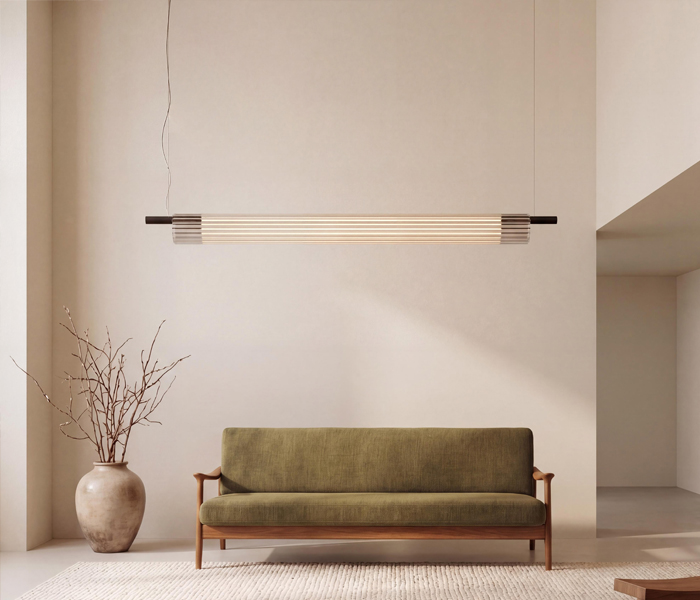
4. Decorative pendants in noble materials. Glass, ceramic or worked metal, where the material matters as much as the light. This is the territory of the Glass collection and its ribbed glass tube, which filters the light and returns it softened.
Modern pendant lights: geometry as the only ornament
Modern pendant lights have traded decorative volume for the clean line. What defines contemporary design today comes down to three gestures:
- Slim profiles and airy structures. The fitting reads almost as a floating line, without blocking sightlines or crowding the ceiling.
- Indirect light. Rather than pointing straight down, many pendants throw light against the ceiling and bounce it back, without a single point of glare. The “Up” versions of the TR collection, such as the TR Up, are built on that idea.
- Matt finishes and neutral palettes. Black, white, graphite, bronze, sand. Colours that accompany the project instead of competing with it.
Composition is the next step: instead of a single piece, several pendants at different heights, or modular solutions like the TR Line, which links modules into one linear structure and lets you draw the light to the measure of the space.
Industrial or glass: two opposite temperaments
The industrial pendant light comes from factories and workshops: wide metal shades, raw finishes, exposed cables and a clearly downward beam. It brings weight and works effortlessly in open kitchens, lofts, spaces of exposed brick or concrete, and hospitality venues with character. Its current reading is more cultivated: the solidity of the metal stays, the excess of vintage detail goes.
The glass pendant light plays at the opposite end. Glass does not hide the light, it tempers it: diffusing, creating reflections and adding warmth without adding visual weight, because the piece is translucent. It is the natural choice above a dining table, an island or an entrance hall that wants to welcome properly. In the Insolit catalogue, the Glass collection offers this language as a pendant with the Glass Pendant, and continues it in table and floor versions so the whole room speaks the same way.
Proportion: where almost everything is decided
A small fitting over a large space does not go unnoticed, it reads as a mistake. These two rules avoid that outcome.
For the diameter of a circular pendant, add the length and width of the room in metres and convert that number into centimetres. A room of 4 x 5 metres therefore calls for a piece of around 90 cm.
If the fitting hangs over a table, the criterion changes: it should measure between 50 % and 70 % of the width of the table, never overhanging its edge. On rectangular tables longer than 1.80 metres, a single circular piece falls short and it is better to move to a linear format or a composition of several pendants. When hesitating between two sizes, the larger one almost always wins.
Height: the detail that separates a good project from an excellent one
It is the parameter most often got wrong and the one that shows most. These are the references we work with:
| Room | Reference height | Type of light | Usual format |
| Dining room | 75 to 90 cm above the table | Downward, dimmable | Linear or circular |
| Kitchen (island) | 70 to 85 cm above the worktop | Downward, concentrated | Spot or industrial |
| Living room | 2.10 m minimum clearance | Indirect or diffuse | Circular or large format |
| Bedroom | 50 to 60 cm above the nightstand | Directed, narrow beam | Spot or headboard fitting |
| Hallway | 2.10 m minimum clearance | Diffuse and warm | Glass or composition |
QWhich pendant each room calls for
Every space follows its own logic and deserves separate analysis. Here are the key points, with the full guide for each case:
Living room. There is no single functional plane to aim the light at, but several zones of life, so the pendant works as an atmosphere piece rather than a focal point. Indirect light, generous scale, dimming. Full guide: pendant lights for the living room.
Bedroom. Here the pendant replaces the bedside lamp and clears the nightstand, with two pieces flanking the bed and narrow-beam light for reading without disturbing whoever sleeps beside you. Full guide: pendant lights for the bedroom.
Dining room. The most demanding case for height and proportion: the fitting has to light the tabletop without cutting the sightline between diners. Full guide: pendant lights for the dining room.
Kitchen. Over an island or bar, task light governs: downward, concentrated and with good colour rendering for working with food.
The quality of the light, not just its quantity
Three parameters decide much of the final result. Colour temperature should be warm in living and resting areas, between 2700K and 3000K, since cold light turns any room clinical. Colour rendering should exceed CRI 90: it determines whether wood, fabrics and food look the way they are. And dimming, via DALI, Casambi or Triac, is what lets one piece carry a dinner, an afternoon of reading and a film night.
The five mistakes that ruin a good pendant
- Hanging it too high. The most common failure, almost always out of fear of knocking into it. The fitting stops doing its job and the space loses the scale you were after.
- Ignoring circulation. In walkways you need a minimum clearance of 2.10 metres from the floor.
- Relying on a single source. No pendant lights a whole room properly on its own. Combine it with wall lights, floor lamps or accent lighting.
- Forgetting the dimmer. Without control, the same lamp has to serve dinner and film night, and it does neither well.
- Overlooking the electrical layout. The ceiling outlet is almost never where you need it. Plan it before closing the false ceiling.
Frequently asked questions
They fall into four main formats. Linear pendants, with an elongated body that covers rectangular tables, bars and kitchen islands. Circular ones, ring or disc shaped, with downward, upward or mixed light, especially suited to living and dining rooms. Spot or single-point fittings, with one concentrated source for accent lighting. And decorative pieces in noble materials, such as glass, where the object carries as much visual weight as the light. On top of this classification there are style variants, most notably the industrial pendant light, with its metal aesthetic and downward beam, and modular compositions that group several pieces into a single structure.
It depends on where it is installed. Over a dining table, the correct distance is 75 to 90 cm between the bottom of the fitting and the tabletop, which usually means 1.50 to 1.65 metres from the floor. Over a kitchen island the reference drops slightly, to between 70 and 85 cm above the worktop. In walkways, or in living rooms where people pass underneath, you need a minimum clearance of 2.10 metres from the floor. Next to a bed, the pendant sits around 50 to 60 cm above the nightstand. If the ceiling is higher than 2.70 metres, add roughly 5 cm for every extra 30 cm of height.
Yes, but choose slim-profile pieces with indirect or upward light, so they do not crowd the space visually or sit at head height. Models like the TR Air are designed precisely for that.
As a rule of thumb, one piece every 60 to 80 cm of worktop, leaving the same margin at both ends. On islands longer than 2 metres, a single linear pendant usually spreads the light more evenly than several separate fittings.
Explore every possibility in Insolit’s collection of designer pendant lamps, designed and made in Barcelona.