 Skip to content

Las lámparas para techos bajos deben resolver dos cuestiones: dejar suficiente altura libre y distribuir la luz Lighting for low ceilings needs to address two requirements: preserving sufficient headroom and distributing light in a way that makes the space comfortable. Low-profile ceiling lights, wall lights and surface-mounted luminaires are all options worth considering, depending on their dimensions and how the room is used.
However, choosing a small fixture does not guarantee a good result. What it illuminates also matters: the floor, the walls, the ceiling or a work surface. A room can have enough light and still feel compressed if all the illumination is directed downwards.
The choice therefore begins with the relationship between the luminaire and the architecture. The aim is to preserve a sense of spaciousness and give each area the light it needs.
What to check before choosing lighting for a low ceiling
The clearance below the installed fixture
The relevant measurement is the distance between the floor and the lowest point of the installed luminaire. To calculate it, consider the complete assembly: the body, stems, canopy and any other projecting elements.
For example, in a room with a ceiling height of 2.40 metres, a fixture with a total drop of 20 centimetres leaves 2.20 metres beneath it. This calculation helps compare options, although it does not, on its own, establish whether a fixture is suitable for a circulation area.
It is also worth checking door and cupboard openings, the presence of beams and the routes people usually take through the room. A luminaire above a table involves different considerations from one in the centre of a hallway.
The relationship between diameter and drop
A low ceiling does not mean you have to choose the smallest-diameter light. A wide fixture with a shallow profile can be better proportioned than a narrow but deep luminaire.
In larger spaces, choosing a fixture that is too small can leave it looking isolated. Consider the plan and section together: how much space the luminaire occupies when viewed from below, and how much volume it introduces between the ceiling and the people beneath it.
The direction of the light
Before choosing a model, define its role.
- Direct light: illuminates surfaces and activity areas.
- Indirect light: uses the ceiling or another surface as a reflector.
- Accent light: highlights a painting, a texture or a particular feature.
Combining these functions avoids asking a single central luminaire to meet every lighting need in the room.
Which types of lighting work with low ceilings?
| Type of luminaire | When to consider it | What to check |
| Low-profile ceiling light | To preserve headroom with a ceiling-mounted fixture | Total installed drop and light distribution |
| Indirect ceiling light | When the aim is to illuminate the ceiling | Required separation, ceiling finish and available height |
| Surface-mounted spotlight | To direct light towards specific points | Size, orientation and visibility of the light source |
| Wall light | To supplement the lighting and keep the ceiling clear | Light distribution, mounting height and projection into circulation areas |
| Recessed luminaire | When sufficient installation space is available | Installation depth and suitability of the mounting surface |
| Pendant light above a table | To define a specific area away from circulation routes | Minimum drop, sightlines and relationship with the furniture |
The selection should be based on actual dimensions. Terms such as “ceiling light”, “compact” or “surface-mounted” do not, on their own, tell you how much space a luminaire will occupy.
Designer ceiling lights: presence without a long suspension
A ceiling-mounted fixture can give the ceiling a distinctive presence without necessarily using long suspension cables. However, this category includes solutions with different lighting characteristics.
TR Ceiling Down: direct light and circular geometry
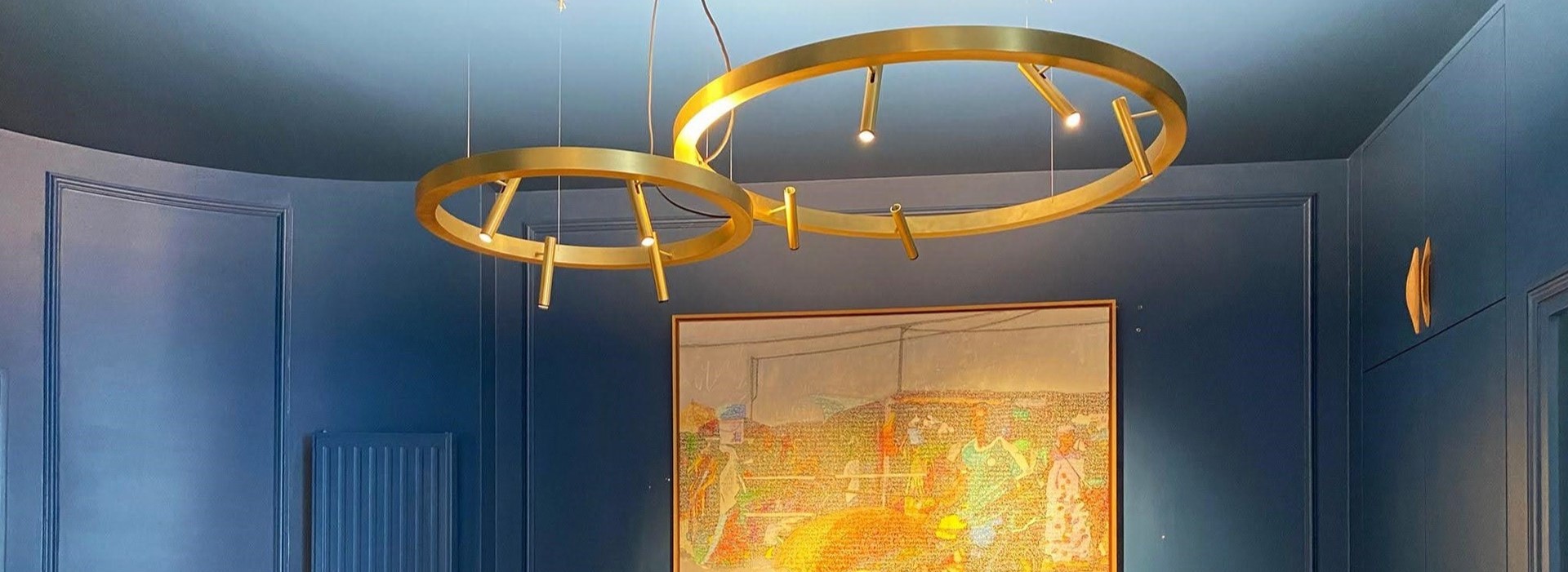
Insolit’s TR Ceiling Down, designed by Josep Lluís Xuclà, is a circular direct-light luminaire made from an extruded and curved aluminium profile. It is installed using stems and a separate surface-mounted canopy.
It can be considered when a project calls for a ceiling fixture with a defined geometry and downward light distribution. In a room with limited ceiling height, the decision should be based on the installation section for the chosen configuration.
Its circular form allows the composition to be considered in plan, but this does not replace checking its drop. Likewise, overlapping arrangements that work in taller spaces should not automatically be transferred to a low ceiling.
TR Ceiling Up: using the ceiling as a reflector
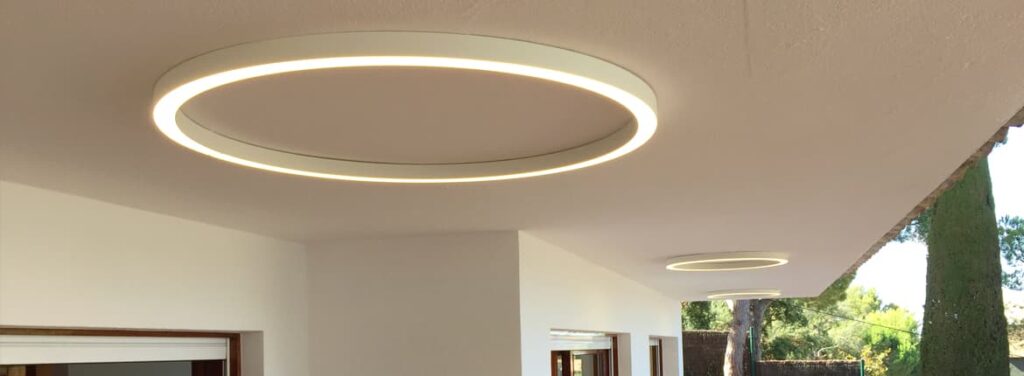
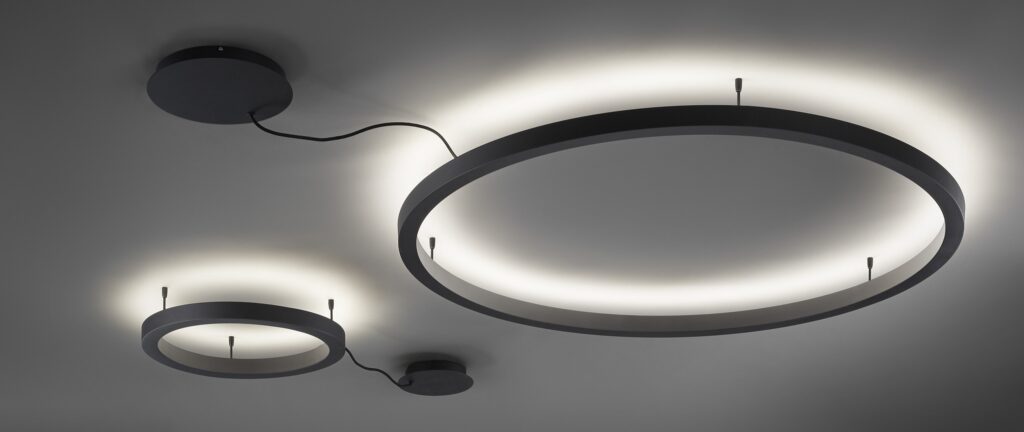
TR Ceiling Up offers an indirect-light alternative. Its technical datasheet describes a circular luminaire that directs light towards the ceiling and is installed using stems.
It is an option to explore when the aim is to brighten the ceiling plane. To assess its suitability, check both the space it occupies and the surface onto which it will project light.
It should not be confused with a fully flush-mounted fixture: its separation from the ceiling is part of how it works. Choosing it therefore requires checking the specific configuration and the resulting clearance.
How to make a low ceiling look higher
Indirectly illuminating the ceiling can help a space feel more open. The effect depends on the distribution of light, the reflectance of the finishes and the relationship between the illuminated surfaces. It does not increase the actual height, but it can change how the room’s volume is perceived.
Avoid directing all the light towards the floor
A series of downward beams may illuminate specific points while leaving the rest of the space insufficiently addressed. It is also worth assessing how the walls and ceiling look from the positions people usually occupy: sitting on the sofa, entering the room or working at a table.
The question is not simply how much light each luminaire provides, but where that light falls.
Create continuity across vertical surfaces
Illuminating a wall can help make the boundaries of a room clearly visible. Two effects should be distinguished: wallwashing aims for a relatively uniform distribution, while grazing light emphasises texture and can reveal irregularities.
In an interior intended to feel visually calm, that distinction matters as much as the design of the fixture itself.
Reduce the accumulation of elements
Where height is limited, choose which elements should take centre stage. Multiple luminaires, tracks, beams and exposed services can compete within a narrow vertical space.
A restrained composition, supported by lighting on walls or within furniture, allows the ceiling to be reserved for the elements that are needed.
How to adapt the lighting to each room
Living room: combine atmosphere and activities
In a living room, it helps to separate the needs of conversation, reading and circulation. A ceiling luminaire can provide the base layer, while other light sources support specific activities.
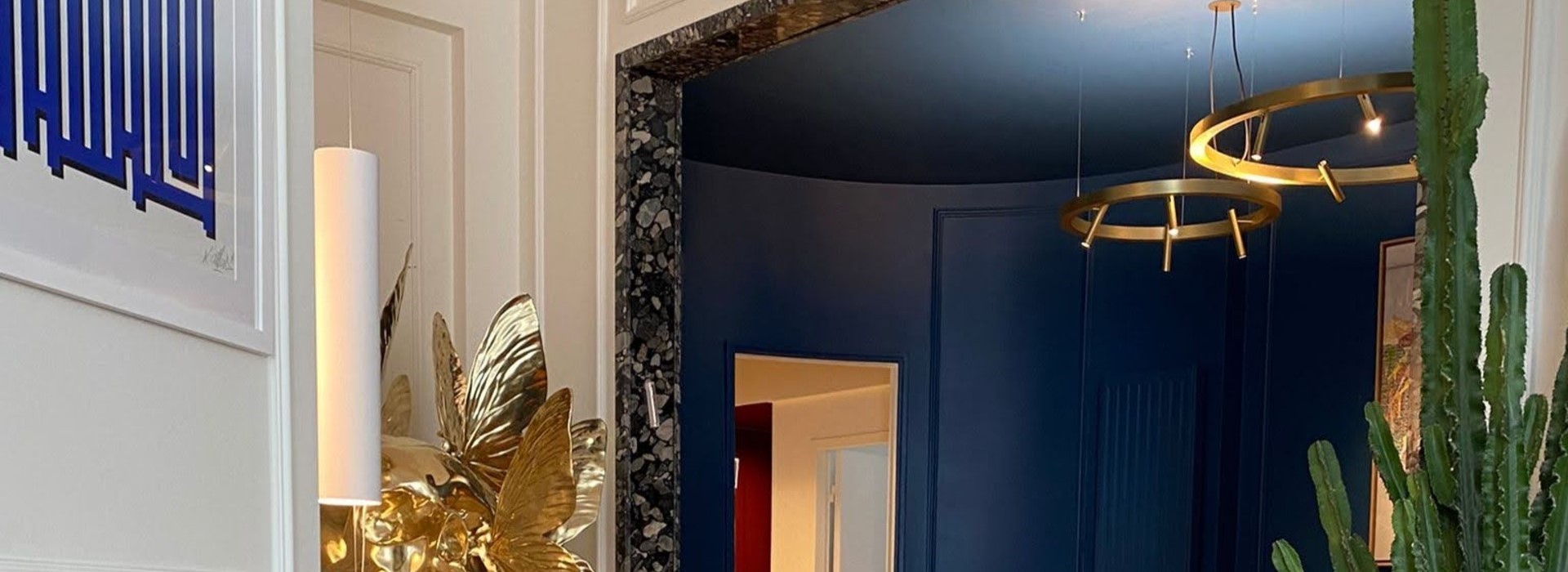
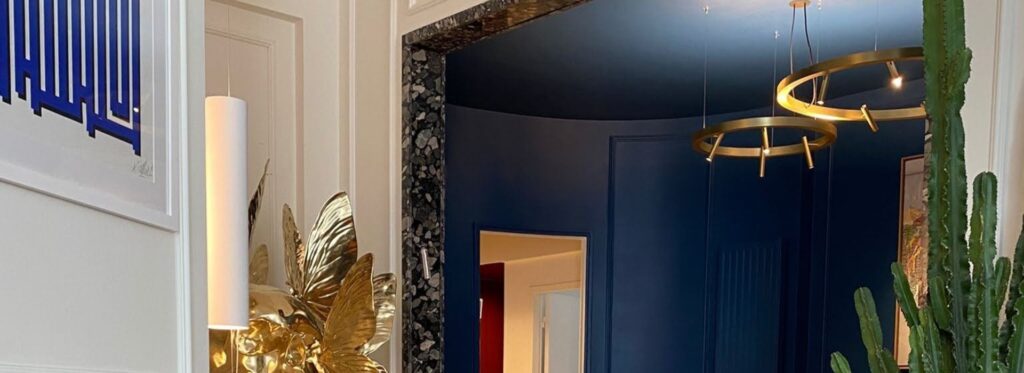
As an example of combining functions, the private residence in Paris incorporates Insolit luminaires to provide ambient and accent lighting and highlight artworks. Its project description identifies TR Up & Stick and Inside Tensor. It is a reference for layered lighting, although the project information does not establish that the home has low ceilings.
Bedroom: consider the view from the bed
Alongside headroom, consider what is visible when lying down. An exposed light source may sit directly within the field of view.
For this reason, review the ceiling light’s position, its light distribution and the possibility of providing separate lighting for reading and ambience. The choice should account for the different positions from which the bedroom is used.
Hallways and entrance areas: keep routes clear
In circulation areas, the drop and projection of fittings require particular attention. It is also worth avoiding unnecessary repetition of fixtures that crowd the ceiling.
The layout should respond to the route, the doors and the features that need to be clearly visible, such as a change of direction or a cupboard.
Dining room: a pendant may be feasible
A low ceiling does not automatically rule out a pendant above a table. It can work if its minimum drop, body size and relationship with the furniture create a well-proportioned composition.
Check that it does not interrupt sightlines between diners or encroach on the route around the table. If the table is moved regularly, also consider what happens when the light is no longer above its intended position.
Mistakes to avoid when choosing lighting for low ceilings
Buying without checking the installation drawing. Photographs do not show precisely how much space a fixture will occupy.
Confusing small size with visual comfort. A small luminaire can still produce uncomfortable light if its source is exposed or poorly directed.
Choosing solely by wattage. Watts alone do not describe the amount of useful light or how it is distributed.
Installing recessed lights without checking the available space. Their integration requires installation conditions that must be understood before selecting a model.
Concentrating all the lighting in the centre. This can leave reading, working or the illumination of walls unresolved.
Find the right luminaire for your project’s ceiling height
Choosing lighting for low ceilings means relating the dimensions of each fixture to the architecture and the way the space is used. Available height, drop and light direction help define a considered selection.
Explore Insolit’s designer ceiling lights and, if you have a defined project, contact us to discuss models, configurations and adaptation possibilities. Sharing the room dimensions and a ceiling section will help assess the options.
Frequently asked questions about lighting for low ceilings
Start by considering low-profile ceiling lights, surface-mounted luminaires and wall lights. The choice depends on the total installed drop and the role the light needs to fulfil.
In circulation areas, preserving clearance takes priority. Above a table, a pendant can be considered if its dimensions and position allow it.
Options include ceiling lights, surface-mounted spotlights, wall lights and recessed luminaires where sufficient installation space is available. Indirect-light fixtures may also be considered if their installation preserves the necessary clearance.
Each type meets a different need. General, ambient and task lighting are usually combined according to how the room is used.
Indirect lighting directed towards the ceiling can help a space feel more open. It should be accompanied by a balanced distribution of light across the walls, avoiding unnecessarily strong contrasts.
The result depends on the ceiling’s colour, finish and geometry, as well as the position of the luminaires.
Light + Building’s 2026/27 trend presentation highlights lightweight forms and soft atmospheres, expressive sculptural pieces and reinterpretations of classic designs. It also emphasises materials and adaptability to different uses.
For a low ceiling, these directions can be interpreted through shallow profiles, carefully chosen finishes and a well-proportioned statement fixture. Trends provide an aesthetic reference; drop and light distribution remain the selection criteria.
It depends on the shape of the room and the activities taking place. A larger-diameter fixture with a shallow profile may suit a spacious room, while several light sources may work better in an elongated layout or across distinct areas.
The number of luminaires should meet a specific need, avoiding extra fixtures added simply to compensate for an inadequate initial choice.