 Skip to content

To light a living room without a false ceiling, you can combine surface-mounted ceiling lights, track spotlights, pendant lights, floor lamps and table lamps. The choice depends on the available height, electrical connection points and activities taking place in the room. These options make it possible to plan the lighting without relying on recessed fittings.
Retaining the original ceiling can also be part of the design intention. A continuous surface, an exposed structure or generous ceiling height all have architectural value. Lighting should respond to these features and provide light where it is needed, without assigning every function to a single central fitting.
Before choosing luminaires: power supply, height and layout
The first step is to draw a plan of the living room with its furniture. The position of the sofa, dining table and reading corner helps establish where light is needed and which directions it should come from.
Next, consider how electricity will reach each luminaire. Choosing not to install a false ceiling does not necessarily mean avoiding building work. Using an existing connection is different from relocating it or adding new ones.
When defining the solution, review:
- Available electrical connection points: their position may influence the installation.
- Cable routes: decide how wiring will be integrated when the luminaire is positioned away from the connection point.
- Space for control gear: if the model requires a separate power supply, its location must be planned.
- The overall drop of the fitting: consider how far the luminaire extends below the ceiling, including rods, brackets or suspension.
- The mounting surface: the fixing method must be compatible with the existing ceiling.
These details should be agreed with the installer before finalising the selection.
Surface-mounted ceiling lights: direct or indirect light
A ceiling light can give lighting a clear presence without introducing a long suspension. Within this category, the direction of the light changes both its function and the perception of the space.
TR Ceiling Down: direct light
TR Ceiling Down is a circular ceiling light designed by Josep Lluís Xuclà and made from an extruded and curved aluminium profile. It provides direct light and has a separate ceiling rose for surface mounting.
The fitting is installed on rods, so its actual drop should be considered when assessing the living room’s ceiling height. Its geometry allows it to become a defined element within the ceiling composition.
TR Ceiling Up: using the ceiling as a reflective surface
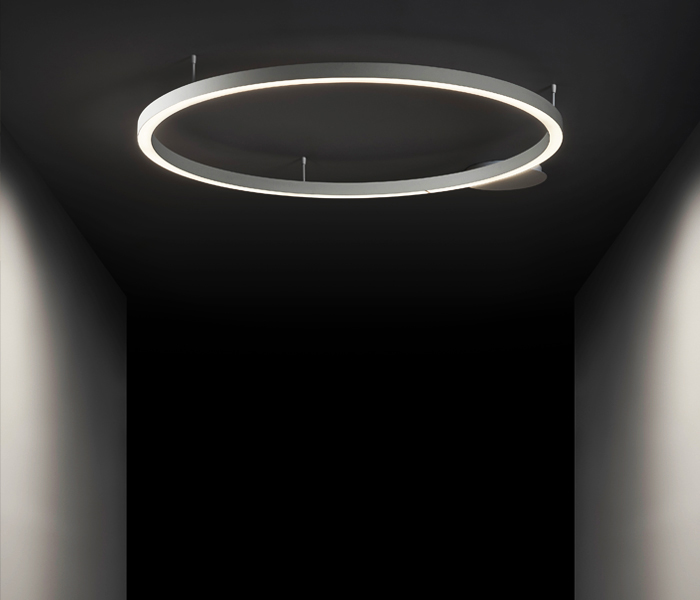
TR Ceiling Up provides indirect light directed towards the ceiling. It shares the collection’s circular design language and also includes a ceiling rose for surface mounting.
When considering this solution, study the ceiling finish and its relationship with the luminaire. The design can give greater prominence to the ceiling plane, complemented by dedicated lighting wherever reading or other tasks take place.

Track spotlights: distributing light around the furniture
A surface-mounted track allows several spotlights to be arranged along a visible line. Its route can relate to a bookcase, a wall displaying artwork or the living room’s longitudinal axis.
Focus Line Track, designed by Jean-Michel Wilmotte, is an adjustable spotlight for three-circuit track. It is made from machined aluminium and accommodates a replaceable GU10 LED lamp, with a GLOBAL GA 69 adaptor.
In a living room, these adjustable light sources can direct attention towards specific surfaces. The track layout should respond to what needs to be illuminated: an arrangement chosen purely for symmetry may not correspond to the final furniture positions.
Before specifying the system, confirm compatibility between the spotlight, track, power supply and controls. The track’s surface-mounting arrangement should also be specified.

Pendant lights: bringing scale to the dining area
A pendant can be installed without a false ceiling when the support, electrical connection and mounting system have been resolved. In a combined living and dining room, it can connect a fitting to the gathering area and visually distinguish it from the seating area.
The table’s position should guide the composition. If the electrical connection does not align with it, the design will need to address how the power supply is extended and how the pendant is fixed.
As a design principle, assess the fitting from several viewpoints: when entering the room, sitting on the sofa and sitting at the table. This helps establish whether its volume complements the space or interrupts sightlines.
Floor lamps: adding light beside the seating area
Floor lamps introduce another light source at furniture level and can give a corner of the living room a stronger presence.
Glass Floor, designed by Josep Lluís Xuclà, combines a fluted glass tube with a steel structure. Its light is controlled by a foot dimmer, allowing the intensity to be adjusted directly at the luminaire.
It can be considered as an ambient lighting piece beside a sofa or armchair. If the same spot is also used for reading, check that the selected lighting reaches the book adequately and remains comfortable from the seated position.

Which solution to choose for each part of the living room
The following table provides a starting point for developing the design. The final choice will depend on the dimensions, finishes and performance of each luminaire.
| Requirement | Solution to consider | What to check |
| Add ceiling lighting without recessed fittings | Surface-mounted ceiling light | Overall drop and light distribution |
| Give prominence to the ceiling | Indirect-light luminaire | Ceiling finish and mounting distance |
| Highlight a bookcase or artwork | Adjustable track spotlights | Direction, optics and potential reflections |
| Define the dining area | Pendant light | Relationship with the table and installation height |
| Create atmosphere beside the sofa | Floor or table lamp | Intensity, position and access to the switch |
| Accommodate several functions | Combination of luminaires | Coordination between light sources and controls |
A residential reference: combining ambient and accent lighting
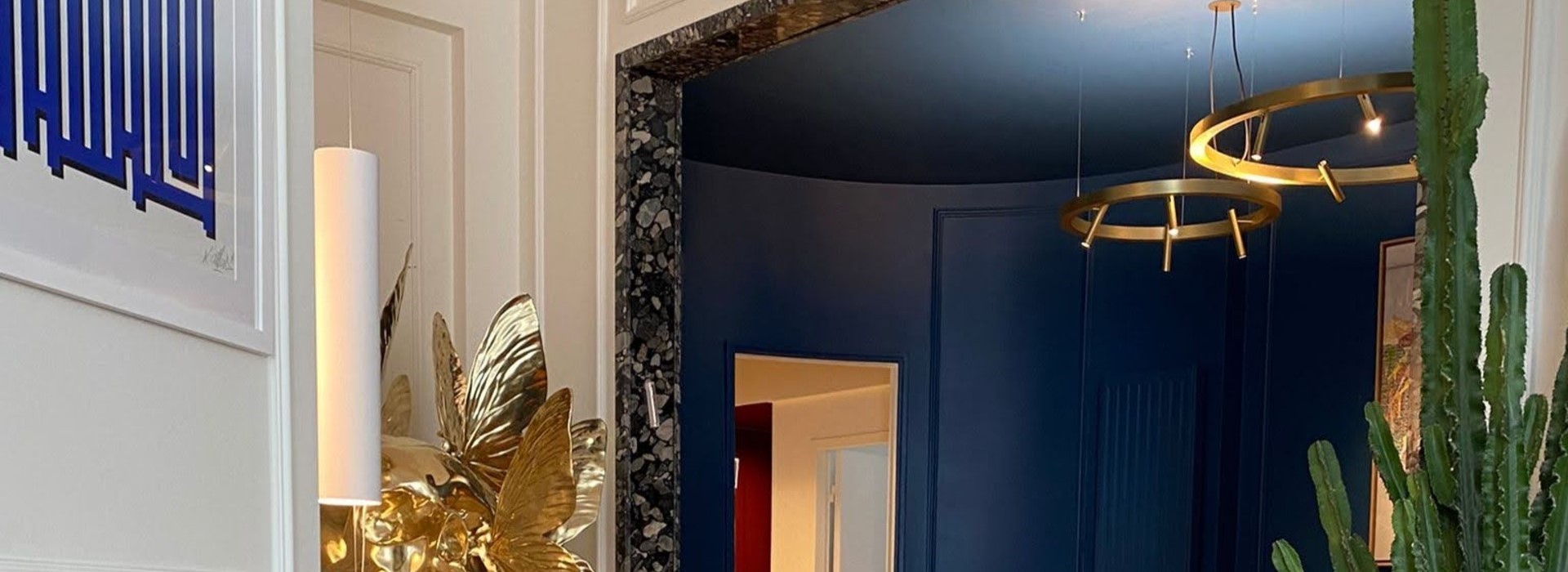
For the private residence in Paris, Insolit documents the use of TR Up & Stick and Inside Tensor.
TR Up & Stick combines indirect lighting with adjustable accent light. The project shows how different contributions of light can work together to complement the architecture, furniture and artworks.
This reference is useful when considering a living room as a set of different needs. When applying that principle to another interior, each luminaire should be selected according to its function and installation requirements.
Luminaires for your living room project
The choice begins with understanding the space: which ceiling you want to retain, where the furniture will sit and what each light source needs to do.
If you are developing a residential project, you can contact Insolit to discuss your selected luminaires, their available options and request a quotation. Providing a plan, the ceiling height and photographs of the ceiling will help make the enquiry more specific.
Frequently asked questions about living room lighting without a false ceiling
You can use surface-mounted fittings, track spotlights and pendants, complemented by floor or table lamps. Start by locating the existing electrical connections and defining how each area will be used. Then select the fittings and plan their installation.
Consider a combination of general lighting, ambient lighting and lighting for specific activities. The reading area, dining table and sofa may require different solutions. Organising lighting by function allows the room to adapt to different times of day.
First, identify where light is lacking: throughout the room, in a particular activity area or on surfaces left in shadow. One possible layout combines a general lighting layer with light directed towards darker areas and lighting close to the furniture. The choice should also take the room’s colours and finishes into account, as these influence the result.
One option is to use pendants to bring the luminaire closer to the area being used, complemented by light sources at other heights. Before choosing, consider the fitting’s scale, the available suspension length and how it will be maintained. A lamp’s visual size and its ability to illuminate are separate criteria that should be assessed together.
Yes. For example, TR Ceiling Up and TR Ceiling Down incorporate LEDs and a separate ceiling rose for surface mounting. Without a false ceiling, you need a model whose installation and power supply arrangements are designed for that situation.
You can explore a new layout using existing connections and adding floor or table lamps where sockets are available. If the design requires relocating a pendant or adding a track, check how electricity will reach the new position.