 Skip to content

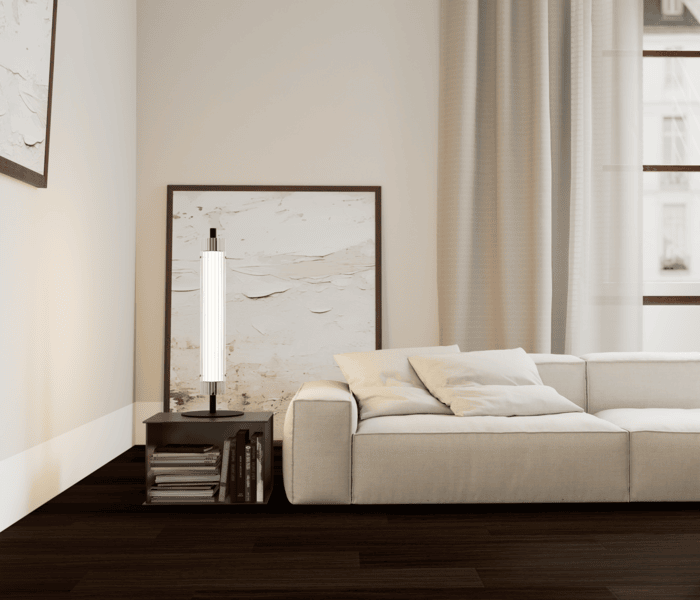
In contemporary interior architecture, table lighting has ceased to be a simple functional complement to become a statement of intent. A designer table lamp for the living room does not limit itself to providing light: it defines atmospheres, establishes visual hierarchies and reveals the character of a project. For architects and interior designers, choosing the right table luminaire is as decisive as selecting the covering of a wall or the colour palette of a space. In our table lamps collection, each piece is born from the conviction that light is the fourth pillar of the construction of the space.
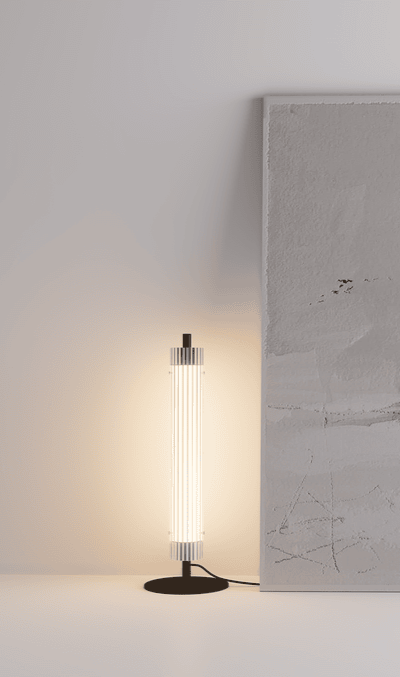
What defines a designer table lamp for the living room: material, light and proportion
When we speak of an authentic designer table lamp, we refer to a piece where every decision —material, finish, light source, scale— responds to a clear design intention. It is not about decorating a side table; it is about introducing an object that dialogues with the architecture of the living room, that brings personality without saturating the space.
Materials are the first language of that conversation. Machined aluminium, stainless steel or ribbed glass not only determine the durability of the piece, but also its visual character: the density of a dark metal, the ethereal transparency of a diffusing glass, the matte warmth of a champagne finish. Each choice of material builds a different narrative on the living room table.
Designer table lamp for the living room: light as a sculptural element
In the living room, the table luminaire occupies a privileged place: it is at eye level, visible both switched on and off. That is why a designer table lamp for the living room must function as an aerial sculpture, a piece with its own presence that keeps its beauty even in luminous silence. The quality of the light it emits —its temperature, its diffusion, its ability to create subtle shadows— is as important as the form of the object itself.
Current LED technology makes it possible to work with compact light sources that do not compromise the formal expression of the luminaire. Replaceable GU10 LED bulbs, for example, offer the specifier the flexibility to adjust colour temperature and power according to the needs of the project, without altering the design of the piece.
Specification criteria: how to choose the right table lamp for each living room
Scale and proportion in relation to the furniture
The table lamp must keep a harmonious proportion with the surface that hosts it and with the general volume of the room. In double-height living rooms or those with high ceilings, a piece with vertical presence provides a necessary visual anchor. In more contained spaces, horizontal lines and compact volumes maintain the balance without competing with the rest of the project.
Type of light and atmospheric function
Not every designer table lamp fulfils the same function. Some are conceived to generate an enveloping and diffuse light that defines the general atmosphere of the living room. Others, such as table projectors, offer a precise directional light, ideal for creating focal points on works of art, bookcases or reading corners.
Materiality and finishes: coherence with the project
The choice of finishes —black, white, champagne, matte anodised— must respond to the material palette of the living room. A luminaire is not an isolated element: it is a piece that completes the material vocabulary of the space. The professional values customisation options that make it possible to integrate the lamp into the visual identity of the project.
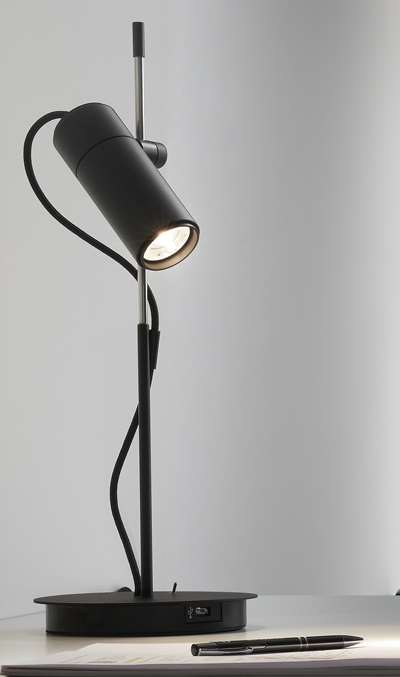
Two approaches to table design: Glass Table and Focus Line Table
Our collection includes pieces that illustrate how a designer table lamp for the living room can respond to very different design sensibilities, always maintaining the demand for artisanal manufacturing that defines us.
Glass Table: transparency as a poetic gesture
Designed by Josep Lluís Xuclà, the Glass Table is a piece where ribbed glass becomes the protagonist. Its glass tube generates a diffuse light that envelops the environment with a floating, almost liquid luminous effect. The body, manufactured in steel tube, incorporates an LED on a PCB designed by Insòlit, which guarantees a high-quality light emission with efficient consumption. It is a luminaire that works as an aerial sculpture on the living room table: it keeps its character and presence even when switched off.
Focus Line Table: precision as a philosophy
Conceived by the French architect Jean-Michel Wilmotte, the Focus Line Table embodies the elegance of the minimal. Manufactured in machined aluminium with a stainless steel axis, this table lamp offers a directional light through a replaceable GU10 LED bulb (up to 10W). Its black textile cable and its integrated On/Off switch reinforce the formal coherence of every detail. In addition, it incorporates a USB 1A input for charging mobile devices, a discreet solution that adds functionality without compromising the purity of the line. Available in white, black and champagne finishes.
Designer table lamp for the living room: the value of being manufactured in Barcelona
Every luminaire that leaves our workshop in Barcelona carries a manufacturing philosophy where the precision of machining coexists with the sensitivity of signature design. This is not a minor detail for the specifier: it means agile production times, real customisation capability and a quality control that only the proximity between design and manufacturing can guarantee. Choosing a designer table lamp for the living room manufactured with this demand is opting for pieces that transcend seasons, that age with dignity and that bring to the living room something that no accessory can replace: a luminous presence with its own character.
The role of the table lamp in the layered lighting of the living room
A well-lit living room never depends on a single light source. Layered lighting combines different levels —general, accent and ambient— to build a space rich in nuances and adaptable to each moment of the day. In that scheme, the table lamp plays an irreplaceable role.
While general lighting provides the base level and the accent points highlight specific elements, the table lamp introduces a proximity light: warm, close and at eye level. It is the layer that humanises the space, the one that turns a correctly lit living room into a welcoming living room.
In addition, the table lamp offers a flexibility that fixed sources lack: it can be switched on independently to create an intimate atmosphere without the need to illuminate the entire room, or relocated as the uses of the living room change. This ability to modulate the atmosphere with a single gesture is what turns it into a project tool, not a mere accessory.
Frequently asked questions about designer table lamps for the living room
What size should a table lamp for the living room have?
The size must keep proportion with the piece of furniture that hosts it and with the scale of the living room. A lamp that is too small goes unnoticed and one that is excessively large unbalances the composition. As a reference, the height of the piece must relate harmoniously to the surface on which it rests.
What type of light does a designer table lamp provide?
It usually offers a warm, proximity light, designed to create atmosphere rather than to light tasks. Some models incorporate diffusers that soften the emission and others make it possible to regulate the intensity to adapt to each moment.
Where is a table lamp usually placed in the living room?
The most frequent locations are side tables next to the sofa, consoles, sideboards and shelves. The key is to place it where its proximity light brings warmth and contributes to the layered lighting scheme.
Discover the pieces that transform the living room with quiet elegance in the table lamps collection by Insolit.